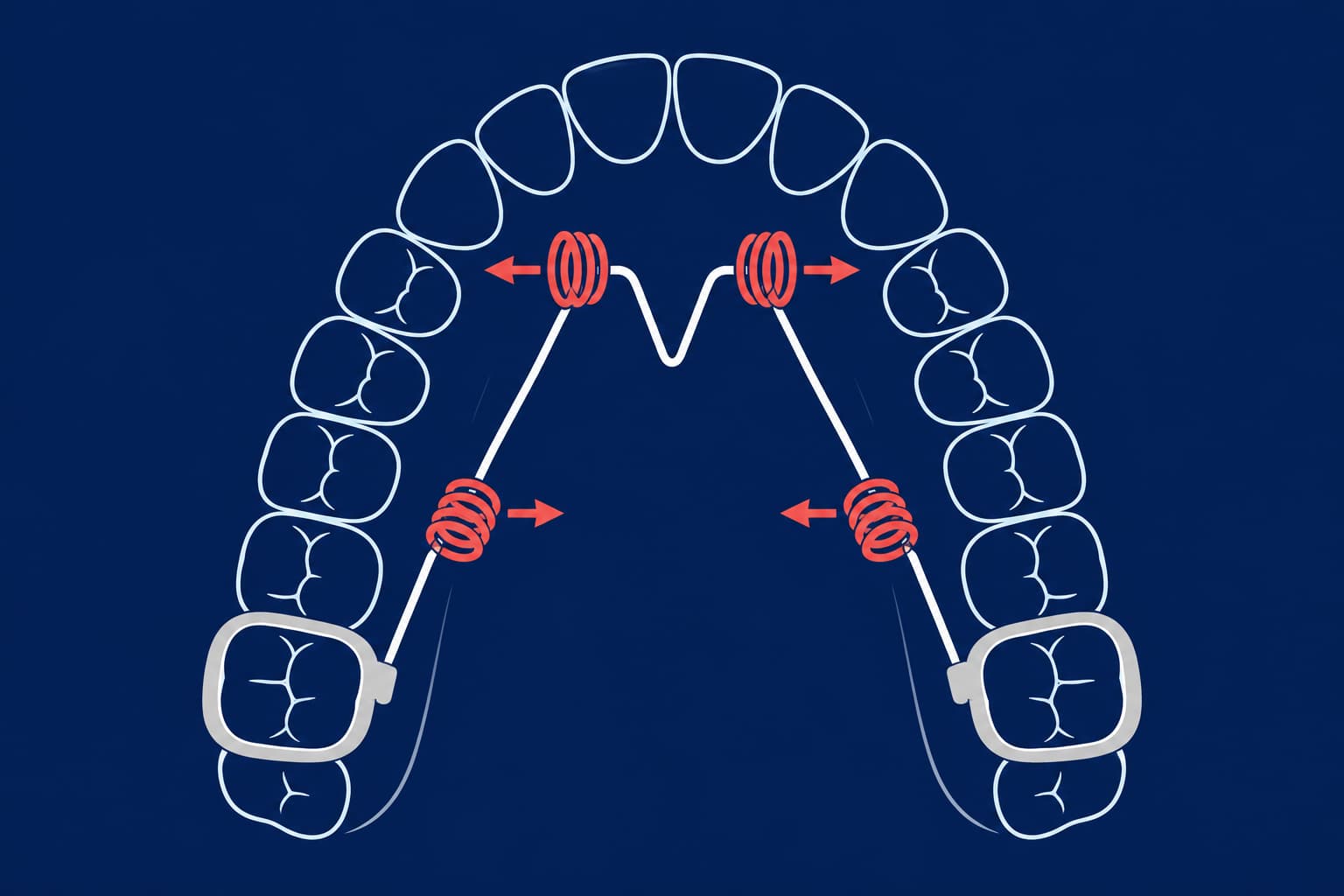
A quad helix is a fixed or fixed/removable palatal wire with four helical loops that slowly widens a narrow upper arch. It is a first-line tool for functional posterior crossbite in children in the early mixed dentition (roughly ages 7–11). It works through gentle, continuous force rather than daily screw turns, so it does not depend on the patient or parents activating it. That does not make it a universal expander. Past the prepubertal growth stage, or when a clinic wants maximal skeletal change, other appliances are usually the better fit.
This guide covers what the appliance is, what the evidence says it achieves, how to choose between a quad helix and a rapid expander, and what matters in lab production.
At a glance
| Question | Short answer |
|---|---|
| What is it? | A W-shaped palatal arch with two anterior and two posterior helices, anchored to the upper molars |
| Typical wire | 0.036 in (0.9 mm) stainless steel or blue Elgiloy; 0.032 in is used in the primary dentition |
| Force | Low and continuous; activated at the chair, not by the patient |
| Typical molar expansion | About 3.7–5.7 mm, and 2.0–3.5 mm at the canines |
| Best for | Dental or functional posterior crossbite in growing children |
| Main limits | Poor cooperation with the fixed appliance, post-pubertal patients, and cases that need mainly skeletal expansion |
What a quad helix is and how it works
Ricketts described the quad helix in 1975 as a modification of the transpalatal Coffin spring. Adding helical loops lengthens the wire between the anchor points, which widens the range over which the appliance delivers useful force. Two loops sit posteriorly and two anteriorly, hence "quad".
Three actions come from one wire:
- Buccal expansion of the upper molars, which is the main effect.
- Distal rotation of the molars, which can be useful when the clinician also wants to rotate or upright the molars.
- Premolar and canine expansion, adjusted through the anterior arms. Their length depends on which teeth are in crossbite. Appliances may extend to the primary canines or permanent incisors.
Because the stiffness of a quad helix depends on the geometry of its loops and the wire diameter, force delivery changes significantly with appliance size and wire gauge. A 1988 laboratory study (activation 8 mm) found it was independent of whether the wire was stainless steel or blue Elgiloy. For the lab, this means the size of the appliance and the wire gauge matter more than alloy choice.
When it is indicated, and when it is not
Good candidates
- Children with functional posterior crossbite in the early mixed dentition. A Cochrane review found that in children aged 7–11, quad helix corrected crossbite far more often than observation alone (OR 50.59) and increased final intermolar distance by 4.71 mm on average.
- Patients with a narrow upper arch and a thumb-sucking or tongue habit, since the quad helix can carry a crib. A published case report of a 9-year-old cemented the modified appliance passive for 2 weeks so the child could adapt, then activated it. Habit-breaking appliances are typically kept in place for 6–12 months as retainers.
- Children with cleft lip and palate who need gradual expansion before alveolar bone grafting, usually at about age 7–10. Slow expansion with a quad helix has achieved crossbite correction in this group.
Poor candidates
- Patients who have passed the prepubertal growth stage. A clinical review also lists poor cooperation as a contraindication, because a fixed appliance still needs oral hygiene and attendance.
- Cases that need a mainly skeletal solution. In the randomized trial cited below, quad helix expansion was more dental than skeletal.
Quad helix versus rapid expansion
Neither appliance is "better" across the board. The trade-offs are specific.
- Success. In a randomized trial of 71 children with unilateral posterior crossbite (mean age about 9.3 years), both achieved similar correction, but the rapid expansion group finished 97 days earlier.
- Cost. A 2024 cost-effectiveness analysis of the same comparison found appliance cost alone was higher for rapid expansion (€202.67 vs €155.58), but total healthcare and societal cost differences were not statistically significant.
- Type of change. A randomized trial in 7–10-year-olds found more dental expansion and molar extrusion with the quad helix, while rapid expansion produced more skeletal change.
- Stability. A systematic review of the quad helix against removable expansion plates found a relapse rate about three times higher with the quad helix at 5.6 years (RR 3.00), though that difference was not statistically significant. Other work found rapid and slow expansion to be similarly stable long term.
- Versus plates. The same review found the quad helix increased intermolar width by 1.25 mm more than expansion plates and shortened treatment time significantly.
A practical rule: if the child is in the early mixed dentition with a functional crossbite and you doubt daily screw activation will happen at home, the quad helix is a rational choice. If speed or a stronger skeletal component matters, consider a rapid palatal expander. Our guide to modern palatal expander types compares the main options.
Activation and retention in practice
Published protocols vary, so the treating clinician sets the plan. Two reference points from the literature:
- An initial activation of about half the buccolingual width of the anchoring molars, which corresponded to roughly 4 mm per side in one study.
- A case report that activated the appliance once a month for 4 months before bonding fixed brackets.
For unilateral crossbite, clinicians sometimes pre-activate the appliance asymmetrically. In one case report, the molar band on the crossbite side was set half a molar width past the buccal surface of the opposing molar.
Retention matters, because relapse is documented, especially in the canine and first-premolar regions. A systematic review concluded that six months of retention with either fixed or removable appliances appears sufficient to avoid relapse in the short term. Some cleft protocols leave the appliance passively in place for a further three months.
Lab production: what the technician controls
The clinician decides the clinical plan. The lab decides whether the appliance seats, stays passive until activated, and expands symmetrically.
Three construction routes
| Route | How it is made | Suits |
|---|---|---|
| Soldered | Bands are placed on the molars, an impression is taken with the bands in it, and the bands are transferred into the impression. The technician pours a working cast, bends the wire and solders it to the bands. A clinical try-in is advised before cementation. | Clinicians who want a fully custom arch and arm length |
| Fixed/removable (lingual sheaths) | Sheaths are welded to the molar bands; the arch is inserted into them and can be taken out for adjustment. Examples are the Wilson 3D quad helix and the 3M Unitek MIA. | Cases needing repeated adjustment or a shorter chairside time |
| Preformed | Ready-made 0.036 in arches, some in blue Elgiloy that need no soldering, adapted to the cast. | Standard arch forms where a ready-made arch can be adapted to the cast |
Soldering is not required for the sheath-based designs. Removable systems avoid recementing or rebanding the whole appliance every time the arch needs changing, which is a clinical advantage the manufacturers highlight.
Details that decide the result
- Band fit comes first. Band fit and a correct cast drive everything else, and some lab prescription forms remind clinicians to retain models and bite registrations until the appliance is seated.
- Gingival clearance. Preformed arches are specified for sufficient clearance from the palatal tissue, so check the wire does not sit against the mucosa.
- Loop position. One clinical description recommends keeping the loops as horizontal as possible, with the anterior loops in the canine region.
- Arm length. Extend the anterior arms only as far as the teeth that need expansion.
- Symmetry. Check the arch is symmetrical on the cast before soldering, unless a deliberate unilateral pre-activation has been prescribed.
Where digital workflows help, and where they do not
The wire itself is still bent and soldered. We found no published evidence that a quad helix is routinely 3D printed as a whole, and we do not claim that it is. Digital steps help around the wire:
- Intraoral scans replace alginate impressions, and STL files feed printed working models.
- Some labs offer custom 3D metal-printed bands in place of standard bands on fixed appliances, including Wilson 3D designs.
- Digital case files are easy to archive, so a repeat order can start from the same data.
If you work in the EU, a lab-made appliance is also a regulated device. Our overview of MDR and QA standards for orthodontic labs explains what documentation to expect.
Common mistakes
- Choosing it for a skeletal problem. If the width deficit is mostly skeletal, the quad helix will tip the teeth rather than widen the base.
- Skipping the try-in on soldered appliances, then discovering the bands do not seat.
- Ignoring the habit. A crossbite caused by thumb sucking will relapse if the habit continues. A crib modification addresses both.
- Retaining too briefly. Plan at least six months of retention.
Where a quad helix fits in your lab workflow
The quad helix is a low-force way to correct narrow upper arches in growing children. It trades speed and skeletal effect for comfort, simplicity and low appliance cost. The result depends on a precise cast, a well-fitted band and a symmetrical, correctly sized arch.
Nordicdens produces Quad-Helix appliances among its fixed appliances for orthodontic clinics. If you want to see how your case files and prescriptions translate into a finished appliance, send your next quad helix case to Nordicdens, and read more clinical and production guides on the Nordicdens blog. If you also work with growing patients, our guide to pediatric space maintainers is a useful next read.