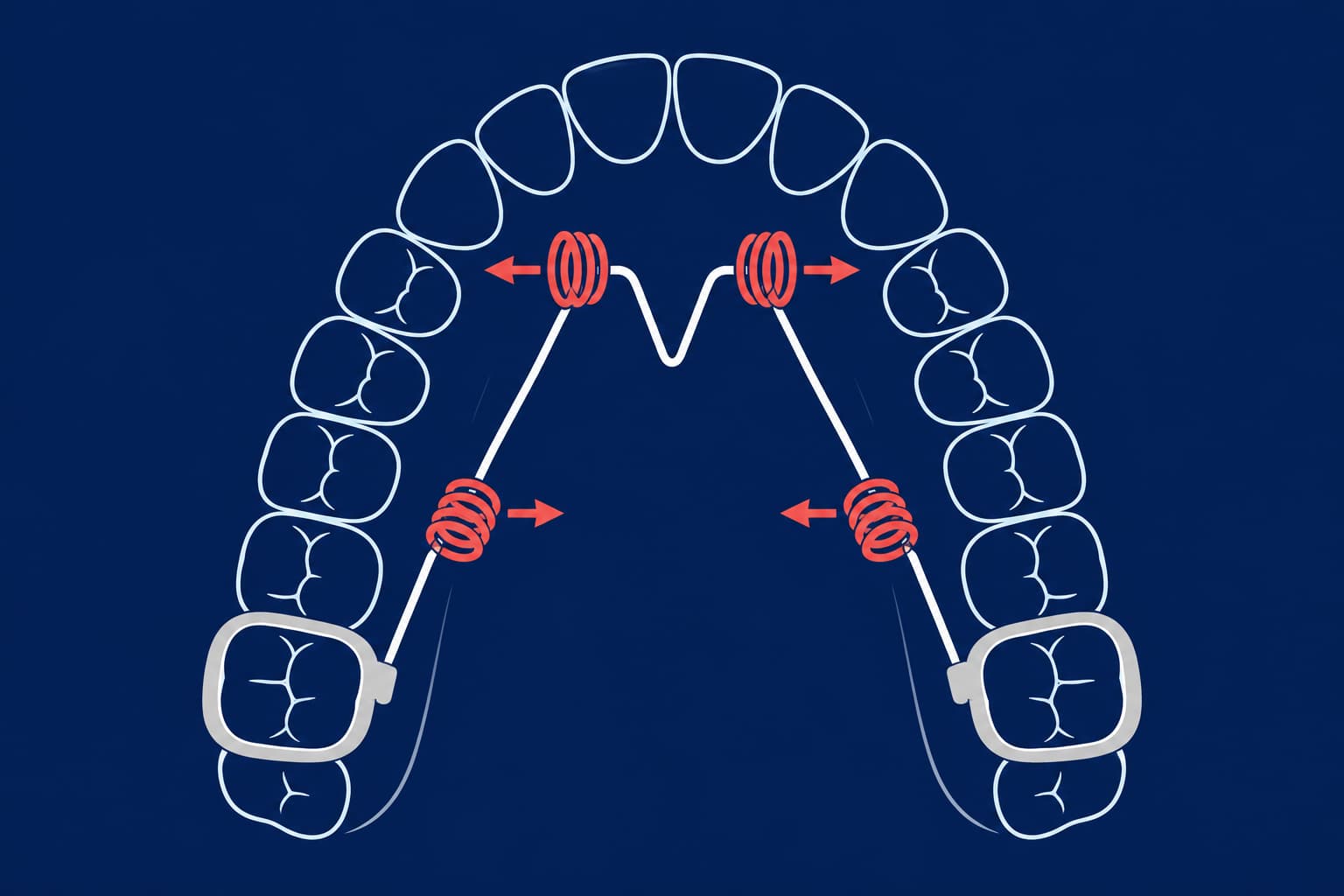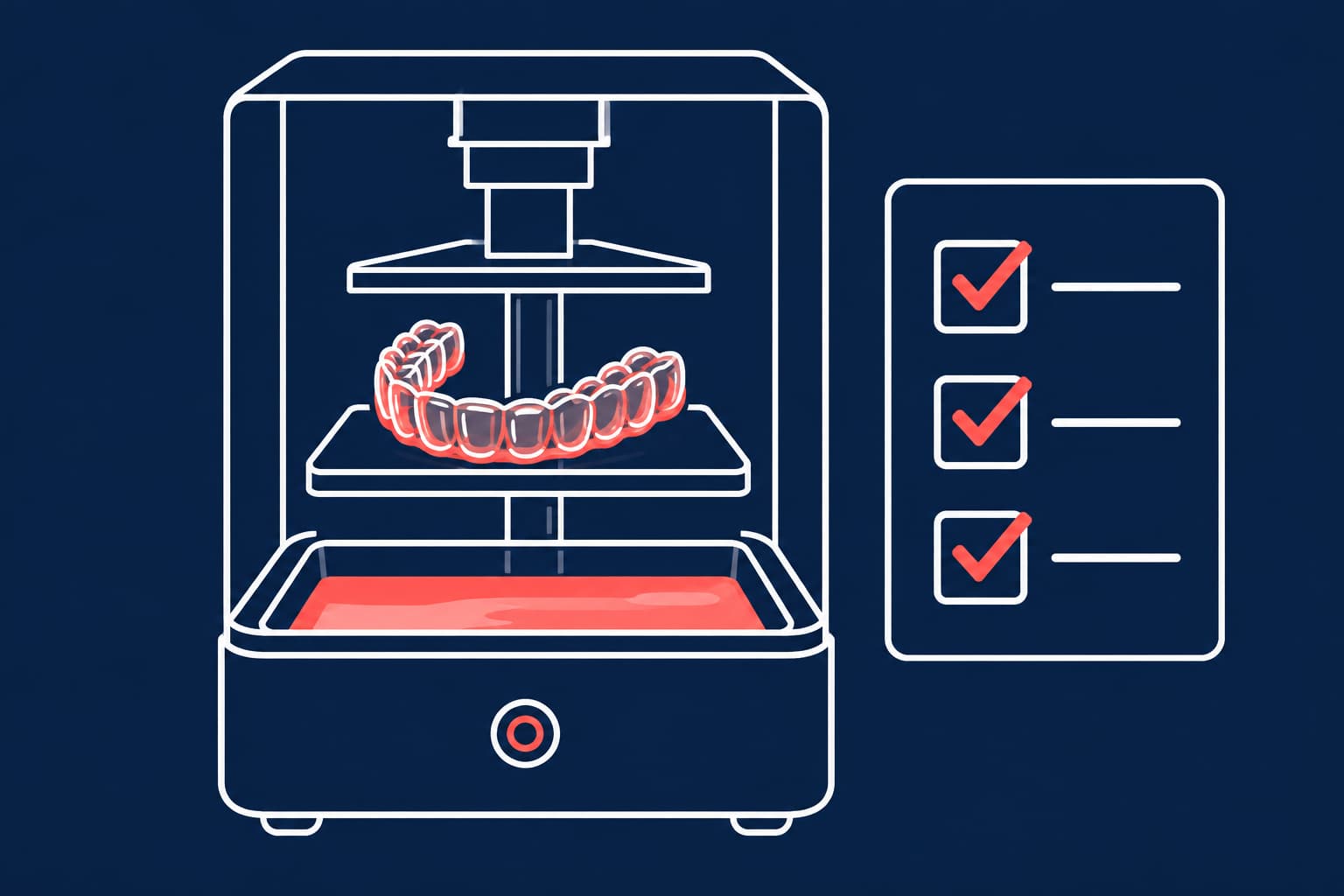
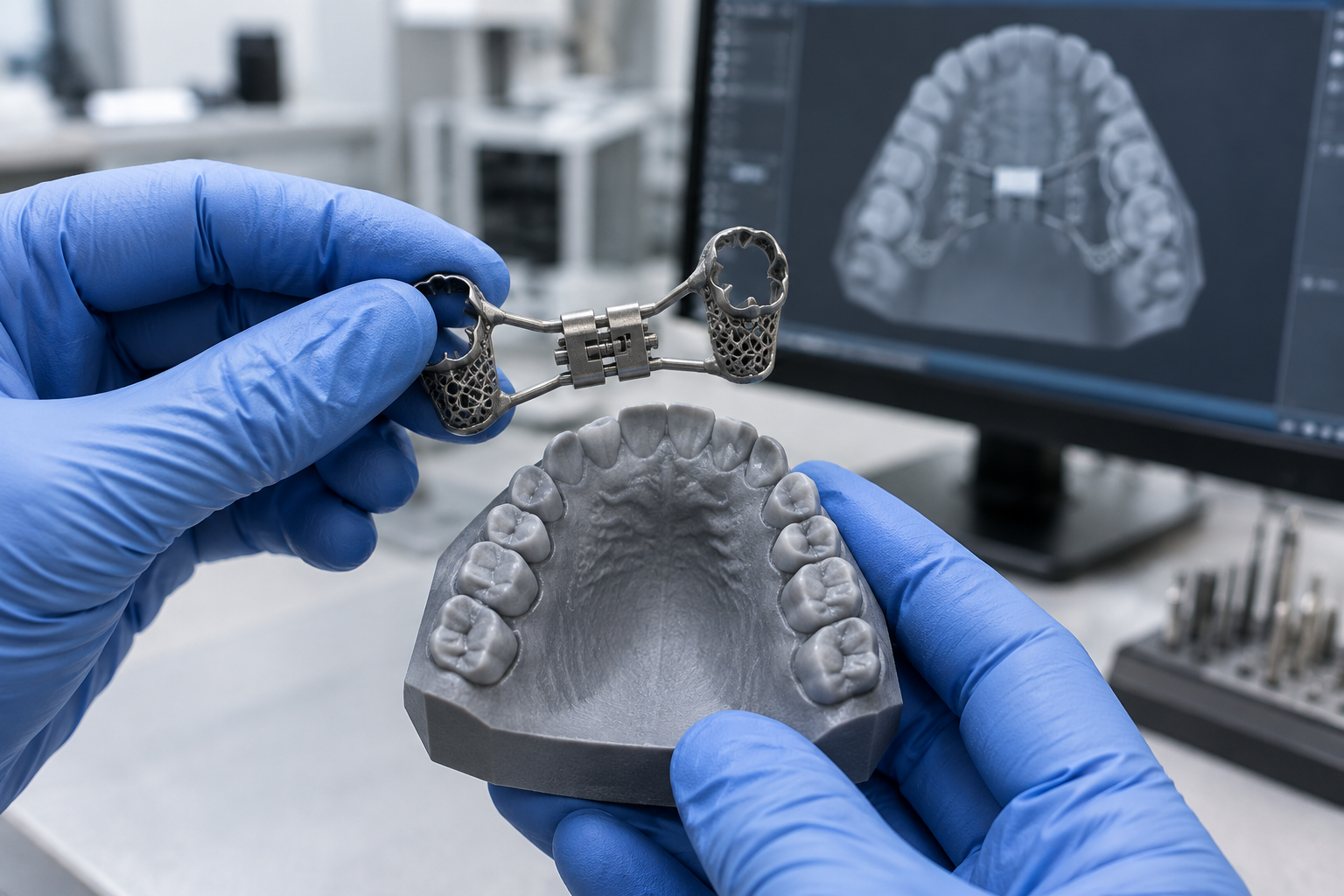
A 3D-printed palatal expander is a custom appliance designed on screen from an intraoral scan and built by additive manufacturing, either as a metal framework (usually cobalt-chromium) that carries a standard expansion screw, or as a removable polymer device. The fit and workflow advantages are well documented. The comparative clinical evidence is still thin, and anyone who tells you printed expanders outperform conventional Hyrax appliances is ahead of the data.
Here is the quick map before the detail.
| Type | Material and build | Anchorage | Typical use |
|---|---|---|---|
| Printed Hyrax-type | Cobalt-chromium, laser melting, screw welded on | Teeth (bonded pads or bands) | Growing patients with transverse deficiency |
| Printed MARPE | Metal framework designed on CBCT and scan, with miniscrews | Teeth and palatal bone | Late adolescents and adults |
| Invisalign Palatal Expander | Polyamide-12, series of removable stages | Teeth | Growing patients, produced by Align |
What "3D-printed expander" covers
The term hides three different things, and they behave differently in the mouth and in the lab.
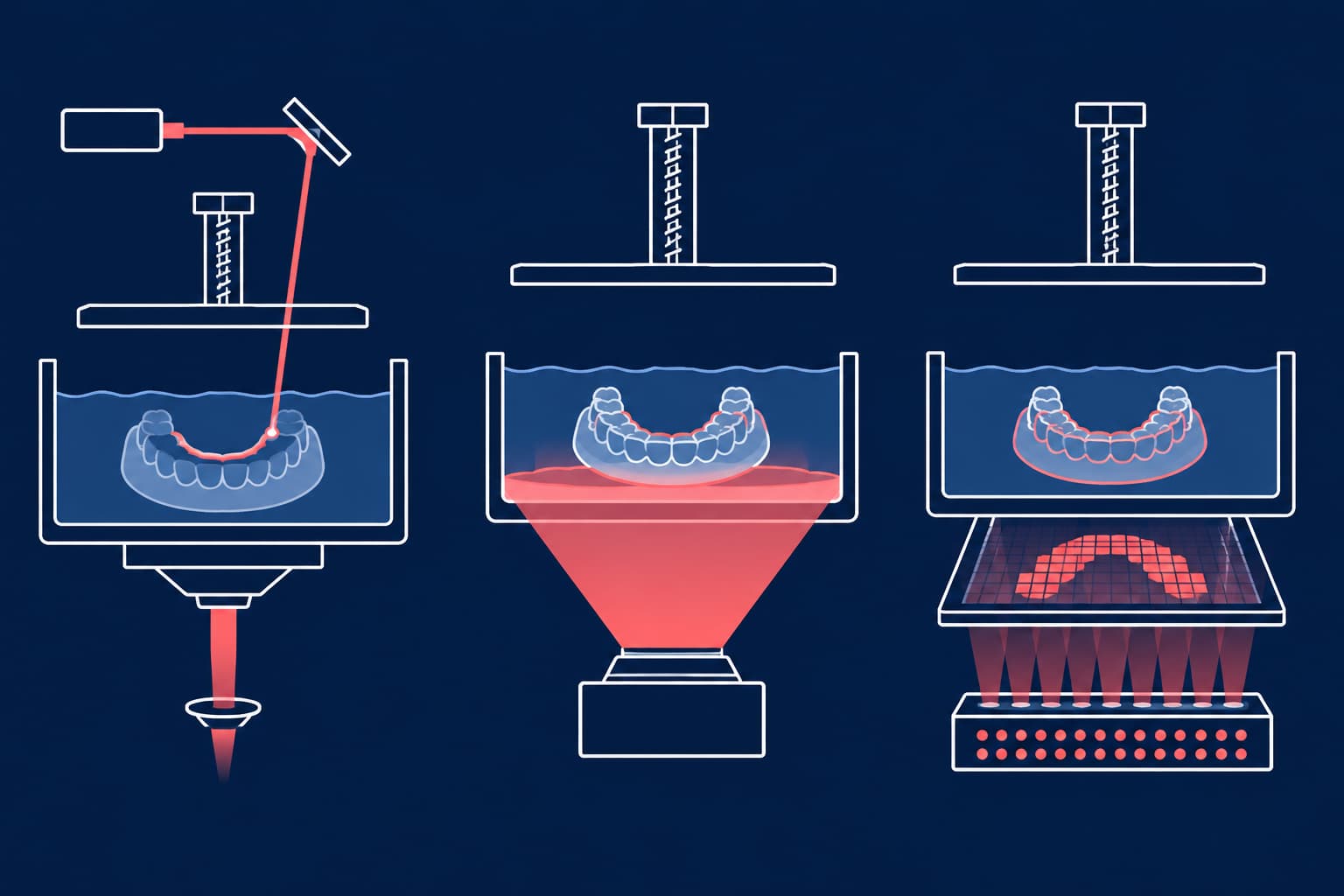
Printed metal frameworks. Cobalt-chromium powder is melted layer by layer by selective laser melting. Titanium is documented for custom miniscrew-supported expanders. The expansion screw is not printed; in the first published workflow it was laser-welded onto the printed framework.
Resin blocks. Journal of Clinical Orthodontics has published an in-office technique for fabricating palatal expanders from 3D-printed resin blocks (Choi, Lee and Yoon, 2023). It is a chairside route, not a lab-made metal appliance.
Direct-printed removable expanders. The Invisalign Palatal Expander is a series of printed polyamide-12 devices with no screw and no metal. It is a manufacturer system, covered in its own section below.
If you want the broader picture of how conventional designs compare, our guide to palatal expander types covers Hyrax, Haas, quad-helix and MARPE.
How a printed metal expander is made
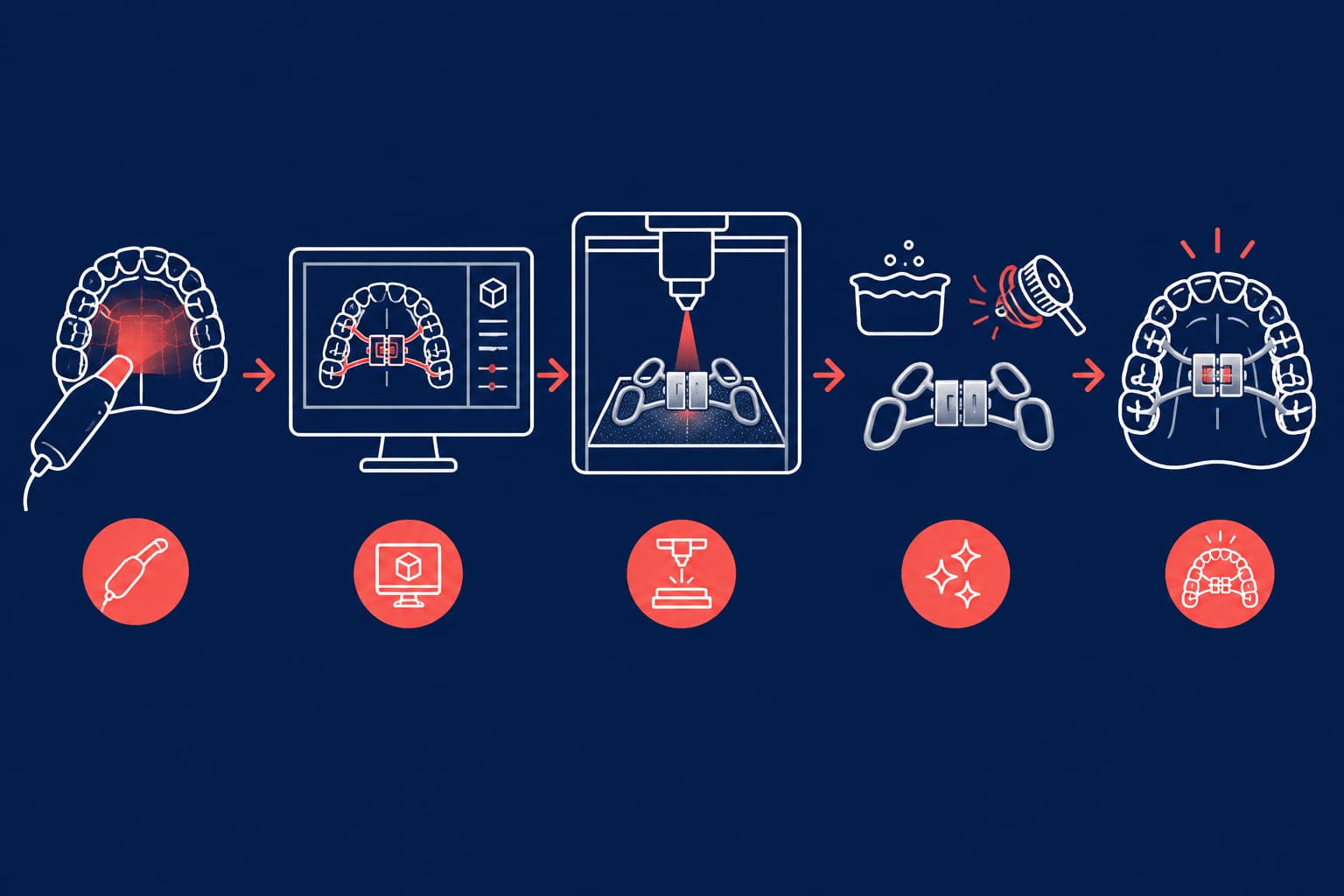
The workflow below follows the metal route described by Graf and colleagues and in later reviews of metal printing in orthodontics.
- Scan. An intraoral scan replaces the impression. Export quality matters here, especially for RPE work; our note on STL files in orthodontics covers scanner settings.
- Design. The lab designs the framework in dental CAD software (3Shape Appliance Designer and exocad are both reported). The screw comes from a library of scanned prefabricated screws and is positioned relative to the palate. One published Hyrax workflow reports 0.75 mm band thickness, a 0.05 mm cement gap and 2 mm connecting arms.
- Print. A laser melts cobalt-chromium powder layer by layer from the exported STL.
- Post-process. Reported steps are annealing to relieve residual stress, removing supports, sandblasting and polishing.
- Join and deliver. The screw is laser-welded to the framework, and the appliance is bonded to the anchor teeth.
Two practical details separate this from conventional lab work. Printed saddle pads can replace molar bands: they cover selected tooth surfaces without extending between teeth, so separators are not needed for fit in some designs.
For resin parts such as models, guides or trays that surround this workflow, orientation and supports decide accuracy; see our build orientation and support rules.
What the evidence actually shows
Be precise about what each study can support.
- Feasibility. The 2017 pilot by Graf and colleagues produced Hyrax appliances for three patients through scan, design, laser melting and welding, with no physical impression. It proved the workflow works, not that it outperforms anything.
- Head-to-head trials are pending. Registered trials comparing 3D-printed and laboratory-fabricated Hyrax expanders (for example NCT05743127 and NCT07411092) list expansion, pain and quality of life as outcomes. The 2026 registration itself states that no clinical evidence yet compares the skeletal and dental effects of the two designs.
- A design caution from simulation. A finite element study found that a fully printed Hyrax transmitted more stress to the maxilla and produced more displacement at the sutures than hybrid and traditional devices. It is a computer model, not a patient outcome, but it shows that a rigid one-piece geometry is not automatically equivalent to a banded one.
- Overall status. A critical review of printable intraoral materials describes the clinical evidence as limited to case reports and proof-of-concept cases.
The stronger data sit in custom MARPE, where digital planning solves a real anatomical problem:
- In a prospective cohort of 34 patients aged 16 and older with the individualised Dutch Maxillary Expansion Device, expansion succeeded in 32 (94.1%). At the first molars the movement was 60.4% skeletal, 8.1% alveolar and 31.6% dental.
- A retrospective comparison of 42 patients aged 16 to 35 found custom 3D-printed MARPE gave comparable or greater width increases than a conventional MSE-II.
- A CBCT-based personalised MARPE series of 18 adults with thin palatal bone (under 2.5 mm) reported treatment without implant failure.
Prefabricated bone-borne appliances can fit the palate poorly, which risks anchorage loss. Customisation addresses that, which is why this is the application where printing has a clinical rationale beyond convenience.
The Invisalign Palatal Expander is a different product
This device sits in the printed-expander conversation but not in the lab-made category. Align describes it as its first direct-printed orthodontic device, produced from an iTero scan. The FDA cleared it through 510(k) K232887 on 15 December 2023 for rapid expansion and subsequent holding of a narrow maxilla in children and adolescents with primary, mixed or permanent dentition, and in adults only together with surgery or other interventions.
How it works:
- Each stage is programmed for 0.25 mm of movement and is made of nylon polyamide-12.
- Align's provider material says expanders may be changed daily or every 2 to 3 days at the doctor's discretion, with holders replaced every 2 to 4 weeks.
- A 2026 pilot comparing it with a Hyrax reported slightly lower discomfort scores with the Invisalign device.
The pilot is small, and the system covers growing patients. It will not replace a bonded screw appliance for a 19-year-old with a mature suture, and an independent lab cannot substitute for it.
Choosing between options
Apply these criteria in order:
- Is the suture still responsive? In growing patients, a tooth-borne appliance (printed Hyrax-type or a removable printed system) is the standard route. In late adolescents and adults, consider MARPE or surgically assisted expansion.
- Is the palatal bone thin? If CBCT shows under 2.5 mm, a digitally planned custom MARPE with guided miniscrew placement is built for exactly this case.
- Will the patient comply with removable wear? A removable expander depends on wear; a bonded one does not. Decide before the scan.
- Do you want to avoid separators? Some printed designs use saddle pads instead of bands, so no separator appointment is needed for fit.
- Is a metal sensitivity documented? Discuss material choice, including titanium, with your lab before design.
One reliability point: a 28-patient study from Kanagawa Dental University Hospital (ages 6 to 36, mean 15) followed 3D-printed fixed appliances including rapid palatal expanders and found age and treatment stage significantly associated with detachment. Plan your bonding protocol and recall schedule for younger patients accordingly.
Common mistakes to avoid
- Treating a poor scan as good enough. Printing reproduces scan errors exactly, including soft-tissue distortion near the anchor teeth.
- Skipping the design review. Check screw position relative to the tooth axes, pad coverage and tongue space on the 3D design before approving it.
- Assuming "digital" means "no verification". Check the fit on the model or in the mouth before cementation, and report any rocking or open margins to the lab so the design can be corrected.
- Overstating benefits to parents. Say printed expanders are custom-fitted; do not claim faster or better expansion, because the trials have not reported that yet.
Planning your next expander case
Digital expanders pay off when the scan, design and print are handled by people who do all three daily. Nordicdens, an orthodontic laboratory in Tallinn serving clinics across the Nordics and Europe, produces RPE and other fixed appliances, including directly 3D-printed work, from intraoral scans. See how the pipeline fits together in our overview of the digital workflow from scan to appliance, and compare orthodontic CAD platforms if you design in-house.
Send your next expander case as an STL file to info@nordicdens.eu and ask the technician to walk you through the design before production starts.