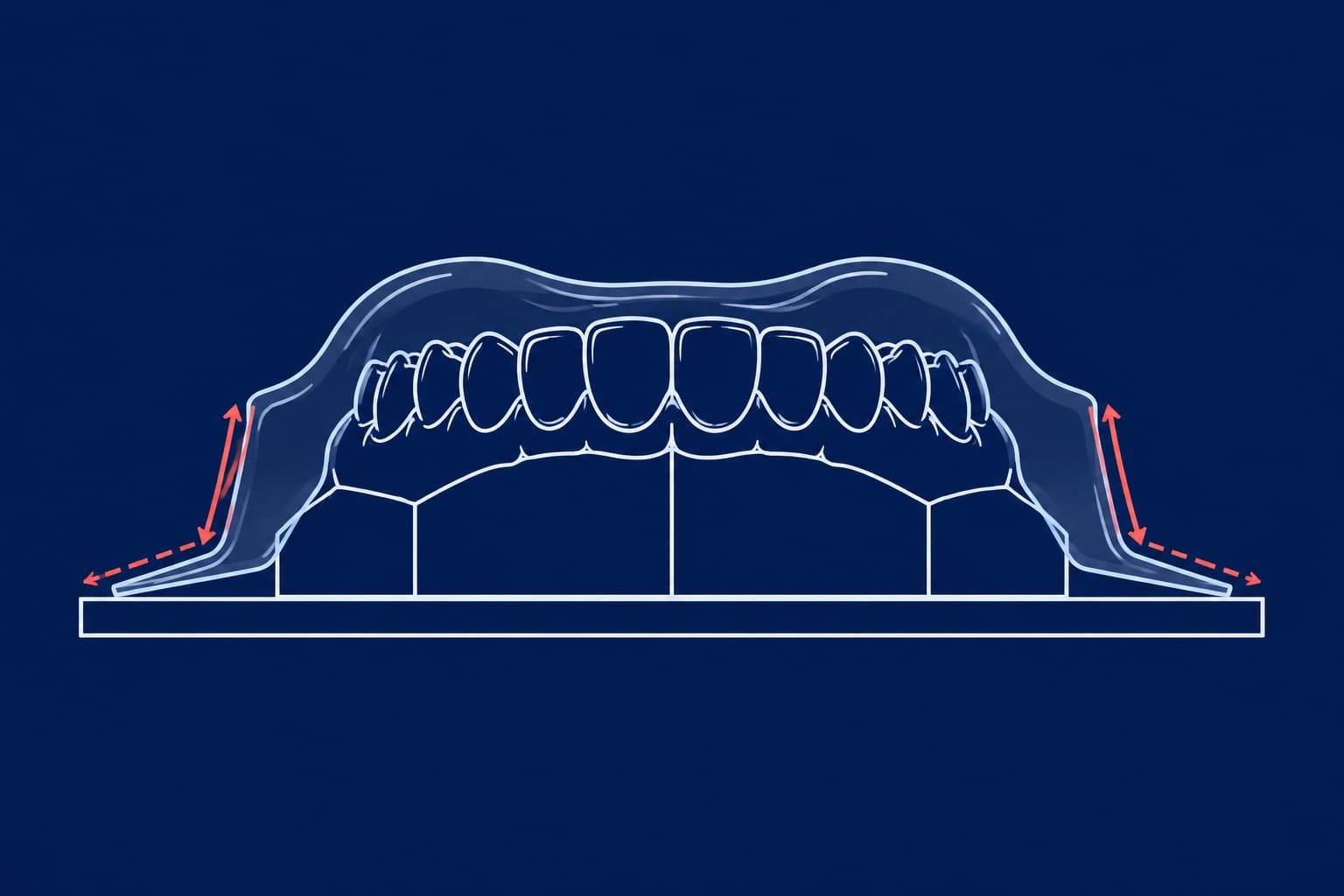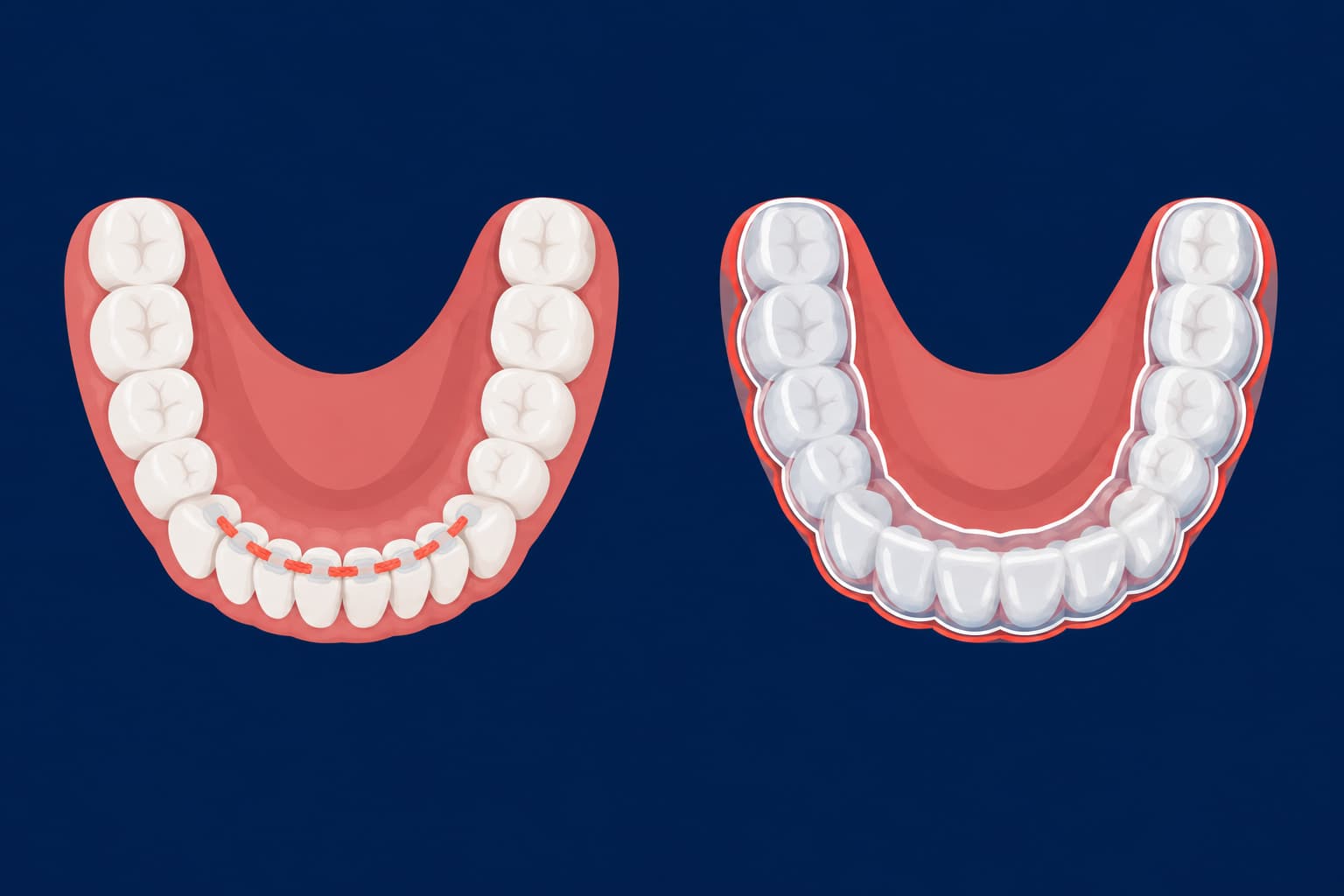
Neither type wins outright. In the lower front teeth, a bonded retainer holds alignment slightly better than a removable one, but it also fails more often than most clinics expect and needs lifelong monitoring. A removable retainer is easier to clean and cheap to replace, but it only works if the patient wears it. The most common Scandinavian protocol is a split: a fixed retainer in the mandible and a combination of fixed and thermoplastic retention in the maxilla, according to a survey of orthodontists in Norway, Sweden and Denmark.
This guide gives you the numbers behind that choice, the criteria for deciding case by case, and what each option means for lab production.
| Bonded (fixed) retainer | Removable retainer (vacuum-formed or Hawley) | |
|---|---|---|
| Patient compliance needed | Minimal | High, and often overestimated |
| Lower-arch stability | Slightly better | Slightly worse |
| Typical failure | Debonding or wire fracture; 35% pooled failure rate | Wear, fracture, non-wear |
| Main hidden risk | Unwanted tooth movement under an intact wire | Relapse from partial wear |
| Hygiene | Plaque retention around the wire | Easier to clean |
| Lab input | Passive wire adaptation, transfer tray or CAD/CAM bending | Model, thermoforming or printing, trimming |
How much better is a bonded retainer at holding teeth?
Slightly, and mostly in the lower arch. A Cochrane review found that thermoplastic removable retainers gave 0.6 mm more lower-arch irregularity than multistrand fixed retainers (Little's Irregularity Index, 95% CI 0.17 to 1.03). That estimate rests on one trial of 84 participants at high risk of bias, so treat it as a signal, not a verdict.
A four-year randomized trial points the same way. Adjusted median relapse was 1.64 mm higher in patients with vacuum-formed retainers than in those with canine-to-canine fixed retainers. Both groups relapsed to some degree, so the bonded wire is not a guarantee.
Two further points matter for the decision:
- A systematic review of retention systems found fixed retention more effective than removable retainers for incisor alignment during the first six months.
- A 2023 meta-analysis found that bonded retainers allowed faster and better posterior occlusal settling than Hawley retainers.
The honest summary comes from the Cochrane authors themselves: the evidence is insufficient to recommend one retention procedure over another. Your case selection matters more than the label on the appliance.
How often do bonded retainers fail?
More often than many patients are told. A 2023 systematic review and meta-analysis of 34 studies and 3,484 participants reported an overall failure rate of 35.22%. The rate climbs with follow-up: 24.18% short-term, 40.09% medium-term and 53.85% long-term.
Several details change how you plan:
- Arch. Fixed retainers fail more often in the maxilla than in the mandible, according to a 2021 systematic review. Across all fixed retainers, adhesive failure is the most common failure type.
- Bonding route. A 2026 meta-analysis found a higher failure risk with direct bonding in mandibular retainers (HR 1.41, 95% CI 1.12–1.79). For maxillary retainers the difference was not significant. An earlier review had concluded that indirect bonding mainly saves chair time, so the evidence is still moving.
- Wire type. Reviews find no wire or fibre splint that is clearly superior for failure rate. One three-year study reported 13.9% failures with dead-soft wire, 4.7% with multistrand stainless steel and 2.1% with CAD/CAM nitinol. Those are results from one study, not general rates per wire.
- Repeat failure. A retainer that has failed once is more likely to fail again, so a second debond deserves a look at your bonding protocol, not just a rebond.
The failure you do not see
A detached retainer is obvious. A retainer that is still attached is the dangerous one. When a fixed retainer breaks but stays bonded to some teeth, or when an intact wire was not passive at bonding, torque on the anchor teeth is the predominant result, according to the AJODO review of inadvertent tooth movement. The pattern is called the twist effect or "wire syndrome", and it can include opposite movements of the canines.
Estimates of how common it is vary widely. One retrospective analysis reported unprescribed movement in 1.1% of 3,500 patients, while a small 30-patient study reported moderate effects in 30%. An in-vitro study measured forces up to 1 N from only 0.2 mm of wire displacement, enough to move a tooth.
The practical rule: a bonded retainer is a commitment to recalls. A retention management protocol, with the patient told to report any loose or rough spot immediately, is part of the appliance.
Removable retainers: where they fail
The weak point is the patient. In a three-month randomized trial with objective sensors, patients averaged 15.3 hours a day with Hawley retainers and 18.3 hours with vacuum-formed retainers, against a 24-hour instruction. A separate trial with a 22-hour instruction found a mean of 14.9 hours a day after three months, even with audiovisual instructions and weekly reminders.
That gap is less alarming than it sounds. A systematic review of retention systems concluded that part-time wear of 8 to 10 hours a day is sufficient for removable retainers. The British Orthodontic Society guideline describes six months full-time followed by six months nights-only for Hawley retainers, which was associated with less relapse than three plus three months.
Between the two removable designs, a systematic review found vacuum-formed retainers better at preventing incisor irregularity relapse, with no difference in survival rates. Patients also rated vacuum-formed retainers higher for satisfaction. It judged the randomized evidence insufficient to settle the question, and our Hawley vs. clear retainer comparison goes through the design differences in more detail.
What about gum health?
Do not assume a bonded retainer harms the gums, and do not assume it is harmless. The evidence is weak in both directions.
- A systematic review of fixed retainers and periodontal health found low-quality evidence in most of its 29 studies. Most found no severe harm, but two RCTs, one prospective cohort and two cross-sectional studies reported poorer periodontal health with a fixed retainer.
- The Cochrane review found less gingival bleeding with removable retainers (RR 0.53, 95% CI 0.31 to 0.88), again from one high-risk-of-bias trial.
- In the four-year RCT above, periodontal outcomes did not differ statistically between fixed and vacuum-formed retainers.
- A critical review citing Salvesen et al. (2021) concluded that prolonged fixed retention does not harm periodontal outcomes in itself. Coexisting factors such as smoking and poor hand dexterity raise the risk of plaque build-up and inflammation.
So hygiene capability belongs in the decision. For patients with reduced periodontal support, a 2025 expert consensus on orthodontic treatment of periodontal patients recommends vacuum-formed removable retainers when inflammation is controlled and bone loss does not exceed one third of the root. With bone loss reaching the middle or apical third, it prefers lifelong retention with a passive fixed retainer, such as multistranded stainless steel wire, with or without additional removable retention.
How to choose: a decision guide
Use these criteria as a starting point. The treating orthodontist or dentist makes the final call for each patient.
- Lower incisors were crowded or rotated before treatment. Lean toward a bonded retainer, ideally bonded to all six anterior teeth. A review found retainers bonded to all teeth maintained alignment better than those bonded to the end teeth only.
- Compliance is doubtful. Choose bonded in the lower arch, and plan recalls. Do not rely on a removable retainer alone.
- Hygiene is poor, or the patient smokes. Favor removable retention, or a fixed retainer with a stricter recall schedule.
- The upper arch is the concern. A fixed upper retainer fails more often than a lower one. Later in retention, vacuum-formed retainers fail more often in the upper arch than bonded retainers, which is one reason dual retention is common in the maxilla.
- Periodontal support is reduced. Follow the bone-loss thresholds in the consensus above.
- The patient will not accept a bonded wire or cannot attend recalls. Removable it is, with a replacement plan.
On duration, there is no consensus. A systematic review states that no protocol has been shown to be the most effective or the right length. The British Orthodontic Society advises long-term wear, in its words "for as long as you want straight teeth". A Norwegian survey found that 41.5% of orthodontists left the mandibular retainer in place for more than five years. Agree the plan in writing before debonding.
What the lab makes: removable retainers
For removable retainers, the lab's decisions are material, thickness, fit and finish.
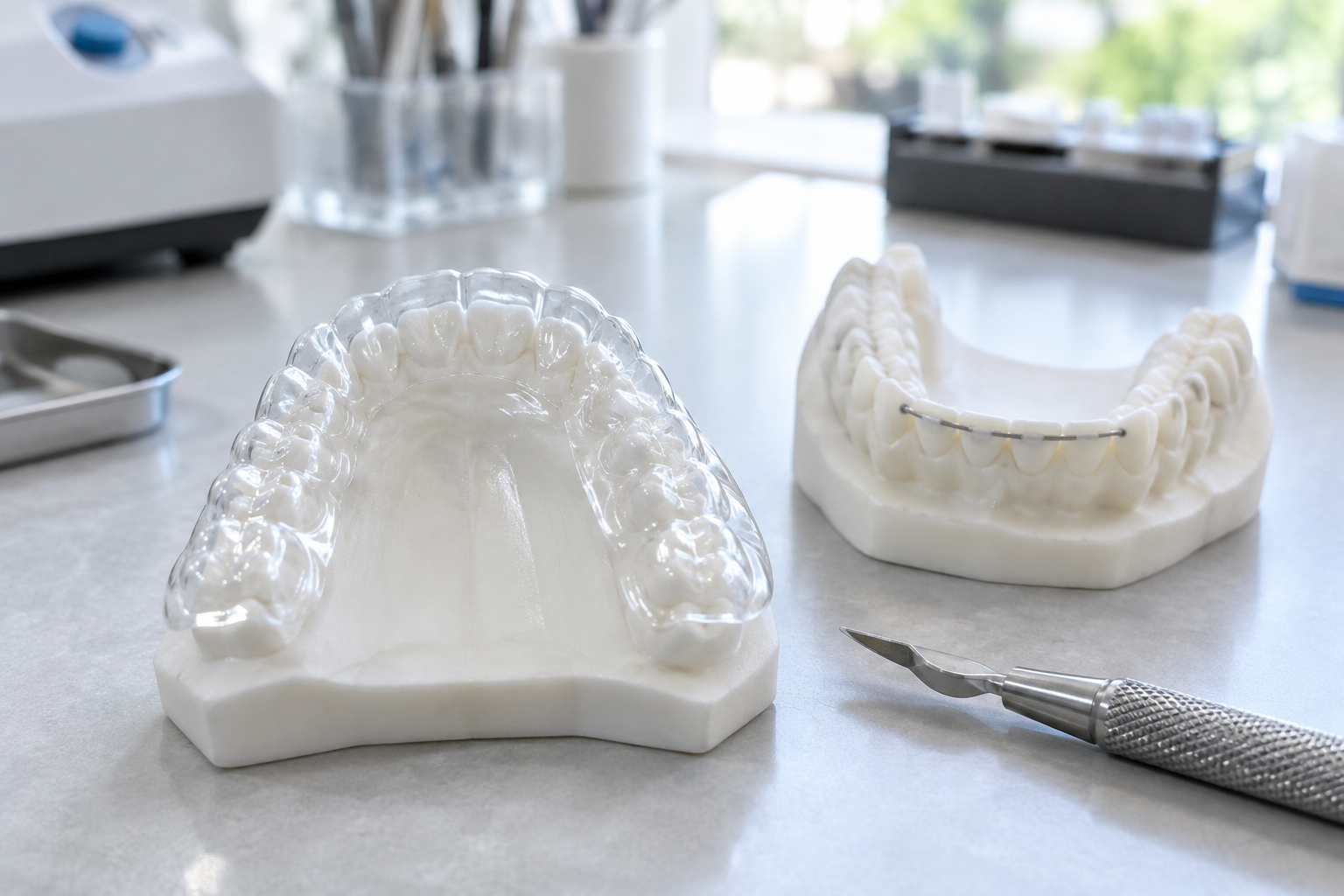
Vacuum-formed retainers. Among specialist orthodontists surveyed, 1.0 mm sheets were prescribed by 68% and 0.75 mm sheets by 16%, usually with full occlusal coverage. One review found no published data showing that thickness changes clinical effectiveness, so follow the prescriber. Material does matter for wear: in a laboratory test of 1.0 mm samples, three polyethylene copolymer materials (Essix ACE, Duran and Tru-Tain) wore significantly less than polypropylene (Essix C+). Undercuts on the model must be blocked properly to retain the retainer without unwanted force on removal.
Hawley retainers. These suit cases where the prescriber wants a wire-and-acrylic design or the patient prefers it. One study found Hawley retainers had a lower adverse effect on periodontal tissue than vacuum-formed ones.
Printed retainers. Direct 3D printing is technically feasible, but clinical evidence is early. A 2026 scoping review found no statistically significant superiority over thermoformed retainers, and one trial showed no difference in six-month stability or satisfaction. In a fit comparison, vacuum-formed retainers deviated least from the reference models, while printed ones deviated most on smooth tooth surfaces and fitted well at incisal edges and cusp tips. We cover the production details in 3D-printed retainers. The model quality behind every one of these starts with a clean scan; see our guide to intraoral scan errors.
What the lab makes: bonded retainers
A bonded retainer is made on a model, then transferred. In the conventional indirect workflow, the wire is adapted passively on a cast, composite pads are placed on the wire, and a silicone tray carries it to the teeth. Models can be stone or 3D-printed.
Two production choices decide whether the retainer behaves:
- Passivity. A wire that is bent to the cast without tension, and seated without being pressed into position, avoids the torque problems described above. Check passivity on the model before the appliance leaves the lab.
- Hand-bent or CAD/CAM. Scan-based design with a bending machine (one 2024 study used the FixR software with a BenderI machine and scanned models) produces repeatable wire shapes. The three-year study cited above reported the 2.1% failure rate for CAD/CAM nitinol. A systematic review also noted one study that was stopped after a high number of CAD/CAM retainer failures, so ask for clinical data on the specific system.
The transfer logic is the same as in 3D-printed indirect bonding trays. However, the studies we reviewed validate lingual bracket trays, not retainer wires, so confirm accuracy for your own workflow. Where a digital file exists, STL files also make replacements straightforward: the same appliance can be reproduced from the stored design.
Choosing the retainer your next case needs
If you want one rule: bond the lower anterior segment when relapse risk or compliance is a worry, add a vacuum-formed retainer in the upper arch (or both arches), and build recalls into the plan. Reserve removable-only retention for patients who can manage it and for periodontal or hygiene situations that call for it.
Before your next debond, decide the retainer type, the recall interval and the replacement route, and write all three into the patient's record. Then bring your next retainer case to Nordicdens and ask how thermoforming and 3D printing can fit your workflow, or browse our other orthodontic appliance guides.