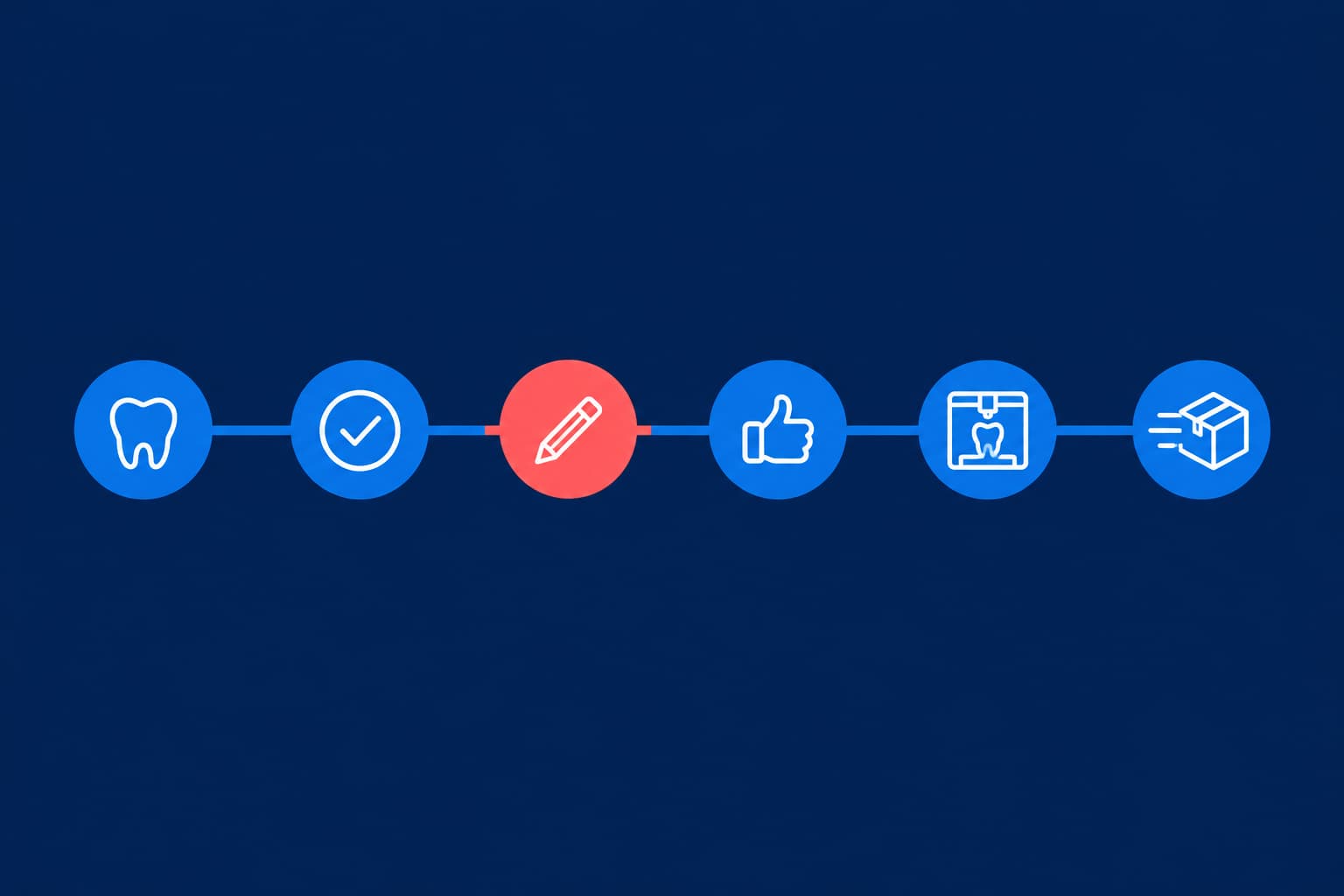
Good case tracking comes down to one case code, six status changes and a timestamp on each. Everything else, from dashboards to push alerts, is built on those. If you can answer "where is case X, who holds it, and what is it waiting for?" in under ten seconds without phoning anyone, your tracking works. If you can't, the cause is usually missing checkpoints, not missing software.
This guide covers what a tracking record should hold, which stages deserve a timestamp, how to read the data, and where the legal obligations around patient data and custom-made devices touch your tracking. It is written for clinics that outsource appliance production and for labs that run their own pipeline.
The six checkpoints worth a timestamp
| Checkpoint | Who triggers it | What it tells you |
|---|---|---|
| 1. Submitted | Clinic | When you handed the case over |
| 2. Logged and validated | Lab | When the production clock really starts |
| 3. Query raised / answered | Lab, then clinic | Where time is lost to missing information |
| 4. Design approved | Clinic | How long your own sign-off takes |
| 5. Produced and quality checked | Lab | Real production time, separate from waiting time |
| 6. Dispatched and received | Lab, then clinic | Transit time, and proof of delivery |
Six is a pragmatic number. Fewer and you cannot tell a lab delay from a clinic delay. More and technicians stop updating statuses by hand, which makes the data worse.
What a tracking record should hold
A status label alone is a weak record. Whatever tool you use, each case needs:
- A case code that is not the patient's name. The code travels in file names, messages and courier labels. Intraoral scan exports in STL format store no patient metadata, so the file name is often the only link to the patient record; a code keeps that link without printing a name on every file.
- Appliance type and the prescription version. If the prescription changes after submission, the record should show which version the technician built from.
- Files and photographs attached to the case, not scattered across email threads.
- A requested delivery date, distinct from the lab's estimated date. When the two differ, you want to learn that at intake, not on the day of the appointment.
- A message thread tied to the case. A query answered by phone and never written down leaves no trace for the next person who opens the case.
- A reason field for holds and remakes. Without it, a remake is an anecdote. With it, it is a pattern.
Tools differ in how they package this. Open Dental, for example, lets a practice attach a lab case to an appointment and mark it sent, received or quality checked, and it calculates a due date from a lab's defined turnaround times while skipping weekends and holidays. Lab-side systems such as 3Shape's lab management software or EasyRx cover prescriptions, files, production workflow and billing in one place. The common core is the same: one record per case, a status history and a deadline.
Why checkpoint two matters most
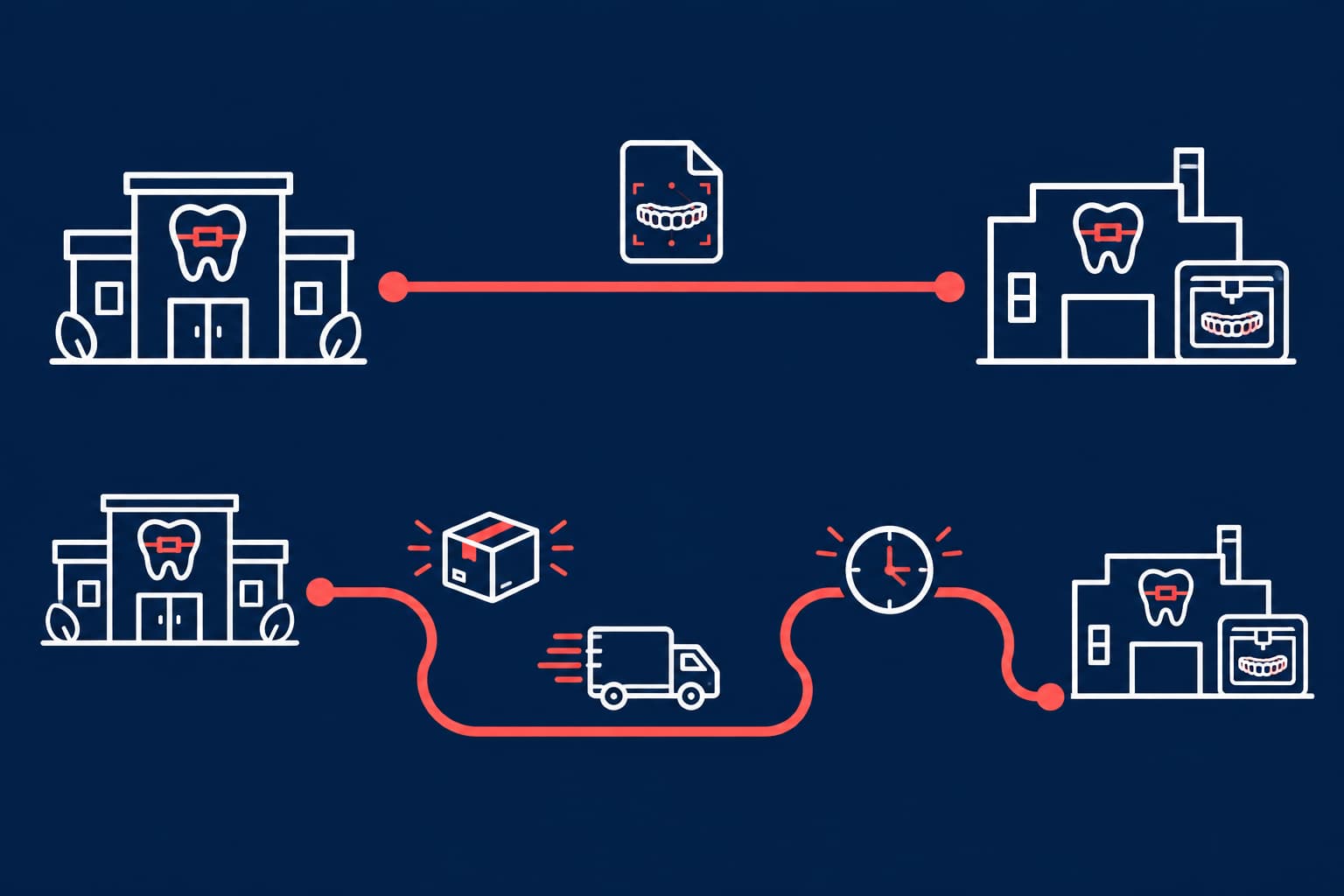
The checkpoint most clinics do not track is the lab's validation of the submission. It matters because a turnaround promise usually runs from that moment, not from the moment you hit send. Our guide to digital scan turnaround times explains why: production starts when the lab logs and validates the submission, and technicians audit the mesh for anatomical completeness first.
So if "submitted" and "validated" are the same timestamp in your records, you cannot see intake holds at all. Record them separately and the gap becomes a measurement. A long gap on one clinic's cases usually points to scan quality or an incomplete prescription; a long gap across all clinics points to lab capacity. Our digital case submission checklist and the article on why lab cases get rejected cover how to shrink it.
A worked example (illustrative numbers)
Suppose a clinic's expander case is submitted on Monday at 15:00 and the lab's estimate is five working days. The timestamps then read:
- Submitted: Monday 15:00
- Validated: Tuesday 10:00
- Query raised Tuesday 10:30 (bite registration missing), answered Wednesday 14:00
- Design approved: Thursday 09:00
- Produced and checked: Friday 11:00
- Dispatched: Friday 14:00
Total elapsed time is 95 hours. The longest single interval, 27.5 hours, was the open query, which no amount of lab speed could have shortened. Without timestamps, the clinic would have recorded "the lab took four days". With them, the fix is clear: attach the bite registration the first time. The numbers are invented for illustration, but the arithmetic is the method: subtract adjacent timestamps and see which interval is longest.
What the evidence says about tracking
Be careful with the claims you see on software vendor pages. The best evidence we found is modest but useful:
- A 2026 study in Digital Health compared a prosthodontic workflow tracking system with a paper workflow for clinic-to-laboratory transfers. The system used timestamped checkpoints, a live dashboard and overdue alerts. Delays occurred in 17.9% of transfer episodes with the system against 52.9% with paper. It measured delays in prosthodontic transfers, not orthodontic appliances and not remakes, so treat it as evidence that visibility reduces lateness rather than a promise for your case mix.
- An audit of 150 prescriptions at a UK dental teaching hospital, published in the British Dental Journal, found 67% non-compliant across orthodontics, removable prosthodontics and conservation technology. The sample is old and from one institution, but it shows why a structured prescription with mandatory fields belongs in any tracking record.
- LMT's 2024 remake survey reports that lab respondents attribute more than 80% of external remakes to dentist error, most often inadequate impressions and wrong shades. That is the lab's view and the figures concern restorations, but the practical lesson transfers: almost half of the surveyed labs track remake percentages by client and use recurring issues as a prompt for a direct conversation.
None of these shows that tracking by itself prevents remakes. Tracking shows you where a problem sits; fixing it still takes a better prescription, a cleaner scan or a design review. For the clinical-data side, see our article on clinic-to-lab data exchange.
Five numbers to review each month
Once timestamps exist, a monthly look at five figures is enough:
- Median time from submission to validation. Anything that drifts upward signals intake problems.
- Queries per case, and the share left unanswered for more than a working day. Open queries are the most common silent delay.
- Median clinic approval time. It is the one interval the lab cannot shorten.
- Cases delivered after the requested date. Count them against the requested date, not the lab's own estimate.
- Remakes by reason and by source. Split them into scan or prescription issues, design issues and production issues. Only the second and third belong to the lab.
If you send fewer than a handful of cases a month, a shared spreadsheet with these columns is adequate. Once several people submit and approve cases, or you use more than one lab, the lack of shared notifications and an audit trail becomes the problem and a portal or lab management system pays for itself.
Where regulation touches case tracking
Two sets of rules shape what your tracking record may and should contain. Neither is legal advice, so check your national rules and your own contracts.
Custom-made devices under the EU MDR. An appliance made to a prescription for one named patient qualifies as a custom-made device under Regulation (EU) 2017/745. The manufacturer has to draw up the Annex XIII statement, which identifies the manufacturer, the device, the patient (by name, acronym or numerical code) and the authorised prescriber. The statement must be kept for at least 10 years after the device is placed on the market, 15 for implantable devices. The regulation text we reviewed sets no extra traceability rules specific to orthodontic labs, but a tracking record that links the case code, prescription, design files and statement makes those documents easy to produce on request. Our overview of orthodontic lab compliance with MDR and QA standards goes further.
Patient data under the GDPR. Data concerning health is a special category under Article 9, and pseudonymised data remain personal data if the person can be re-identified. If a lab processes patient data on a clinic's behalf, Article 28 requires a written contract setting out the processing. Whether a clinic and lab act as controller and processor in a given arrangement depends on the facts. Using case codes and an encrypted portal instead of email attachments reduces exposure; our article on lab GDPR and patient data offers a contract checklist.
How to pick tracking for your clinic or lab
Choose by the problem you have:
- Clinic whose staff keep phoning the lab: you need a portal where status, messages and approvals sit on one case page. Ask whether the lab pushes notifications and whether you can approve a design from a phone.
- Clinic using several labs: ask for a tool that sits on your side, such as a practice management lab-case module, so every lab's cases appear in one list.
- Lab with in-house production: you need configurable workflow stages, deadlines, search by clinic, patient code and stage, and a remake reason field. Check that statuses can be set with a scan or a drag, not typed.
- Lab or clinic with a digital pipeline: check integration with your scanners and CAD software, otherwise someone re-types the prescription and errors creep back in.
Whatever you choose, test it on a bad day: ask the vendor how you would find a case whose file name was mistyped, and how a remake is linked to its original.
How tracking works at Nordicdens
At Nordicdens you submit a case as an intraoral scan, a physical impression or both, with a detailed prescription, and it is logged instantly in our tracking system. For digital cases, STL or PLY files, clinical photographs and the digital prescription go through a secure portal. Each case has its own page in the doctor portal showing current status, digital setup, pricing and the conversation with the technician. Design approvals arrive as a text message with a direct link to approve or decline, and we state a response time under 24 hours. Finished cases leave by express courier. We do not publish a fixed production turnaround, because it depends on appliance type and on how clean the submission is.
If you are weighing whether to hand production to a lab at all, our piece on strategic lab outsourcing covers the decision, and our questions to ask a lab about 3D printing lists what to ask about intake and status visibility.
Your next step: time one case end to end
Pick the next appliance you send out, give it a case code, and write down the six timestamps from the table above. After two weeks you will know which interval costs you the most time, and whether the fix sits with your scan, your prescription, your approval or your lab. If you want to see the result in a tracking portal instead of a spreadsheet, send your next case to Nordicdens as an STL or PLY file with photographs and a digital prescription, and follow it from intake to courier dispatch on its case page.