A resin is not biocompatible on its own. Biocompatibility belongs to the finished appliance: the resin, the printer, the washing step, the post-cure and the way the device is used. A "biocompatible" label on a bottle tells you what the manufacturer tested under its own validated protocol. It does not tell you what comes out of your wash bath and curing unit.
If you prescribe or produce printed aligners, retainers, expanders or bonding trays, these five checks decide whether the claim holds in practice:
| Check | What to verify | Why it matters |
|---|---|---|
| 1. Intended purpose | The resin's stated use matches your appliance and wearing time | Contact duration sets the required tests |
| 2. Certification | A current CE certificate, and under which regime (MDD or MDR) | Older certificates expire |
| 3. Protocol | Wash solvent and time, post-cure wavelength, time and atmosphere | Residual monomer is the main controllable risk |
| 4. Composition | Photoinitiator and other flagged substances in the safety data sheet | TPO is now classified as toxic for reproduction |
| 5. Records | Wash and cure parameters logged per batch | Without records you cannot show conformity |
What "biocompatible" means for an orthodontic resin
The framework is ISO 10993-1, which treats biological safety as a risk-management process rather than a single test. The 2025 edition is the sixth. For dental devices, ISO 7405:2025 adds biological test methods and is meant to be used together with the ISO 10993 series.
Contact duration decides which endpoints you need:
- Limited: up to 24 hours.
- Prolonged: more than 24 hours up to 30 days.
- Long term: more than 30 days.
A retainer worn for months falls into the long-term category by definition. That is the strictest tier, and the FDA's chemical-characterization guidance pairs it with exhaustive extraction rather than the shorter exaggerated extraction acceptable for limited contact.
The test you will see quoted most is ISO 10993-5, the in vitro cytotoxicity test. Cells are exposed to the material or its extract, and a drop in viability of more than 30% (viability below 70% of the untreated control) counts as a cytotoxic effect. Sensitization is covered by ISO 10993-10:2021. The mechanical requirements for orthodontic polymers sit in a different standard, ISO 20795-2:2013, which applies to orthodontic base polymers and copolymers. Passing a mechanical standard says nothing about leachables, and vice versa.
One limit you should know about: cytotoxicity results are hard to compare between papers. A 2026 scoping review of 25 studies on printed aligners and retainers found extraction times ranging from 24 hours to 14 days. Twenty-four hours was the most common choice, in 9 of 19 studies that used extraction. A resin that passes at 24 hours has not necessarily been tested for what it releases in week two.
Where the biological risk comes from
Photopolymer resins are built from acrylate oligomers and monomers, cured with a photoinitiator. If curing stops short, unreacted monomer and initiator stay in the part and migrate out into saliva.
Two substances deserve your attention.
Residual monomers. Urethane dimethacrylate (UDMA) is the best-known example in printed aligners. Published work on printed aligners reports considerable variability in the amount of UDMA released between samples. That variability, not an average figure, is the concern, because it points to process sensitivity.
Photoinitiators, especially TPO. Diphenyl(2,4,6-trimethylbenzoyl)phosphine oxide (TPO) is a standard initiator in dental printing resins. Its harmonised EU classification is toxic for reproduction, category 1B (H360Fd), and that classification applies from 1 September 2025. It has also been on the REACH candidate list of substances of very high concern since June 2023. In cosmetics, TPO has been prohibited since 1 September 2025 under Commission Regulation (EU) 2025/877.
Be precise about what that does and does not mean. The cosmetics prohibition does not automatically apply to dental resins, and the sources reviewed here do not show a blanket ban for dental printing. What the classification does is raise the bar for your risk assessment under the MDR. It also explains why some manufacturers are moving to alternatives such as TPO-L, which one in vitro study found to have excellent biocompatibility and colour stability. That is a single laboratory study, not a clinical verdict.
The reassuring finding comes from a study of residual TPO in cured printed materials. Uncured resin can contain TPO above toxicological safety limits, yet adequate curing significantly reduced TPO elution, leaving a very low toxicological risk. The conclusion is the same as everywhere else in this field: the cure is the safeguard.
Post-processing makes or breaks the result
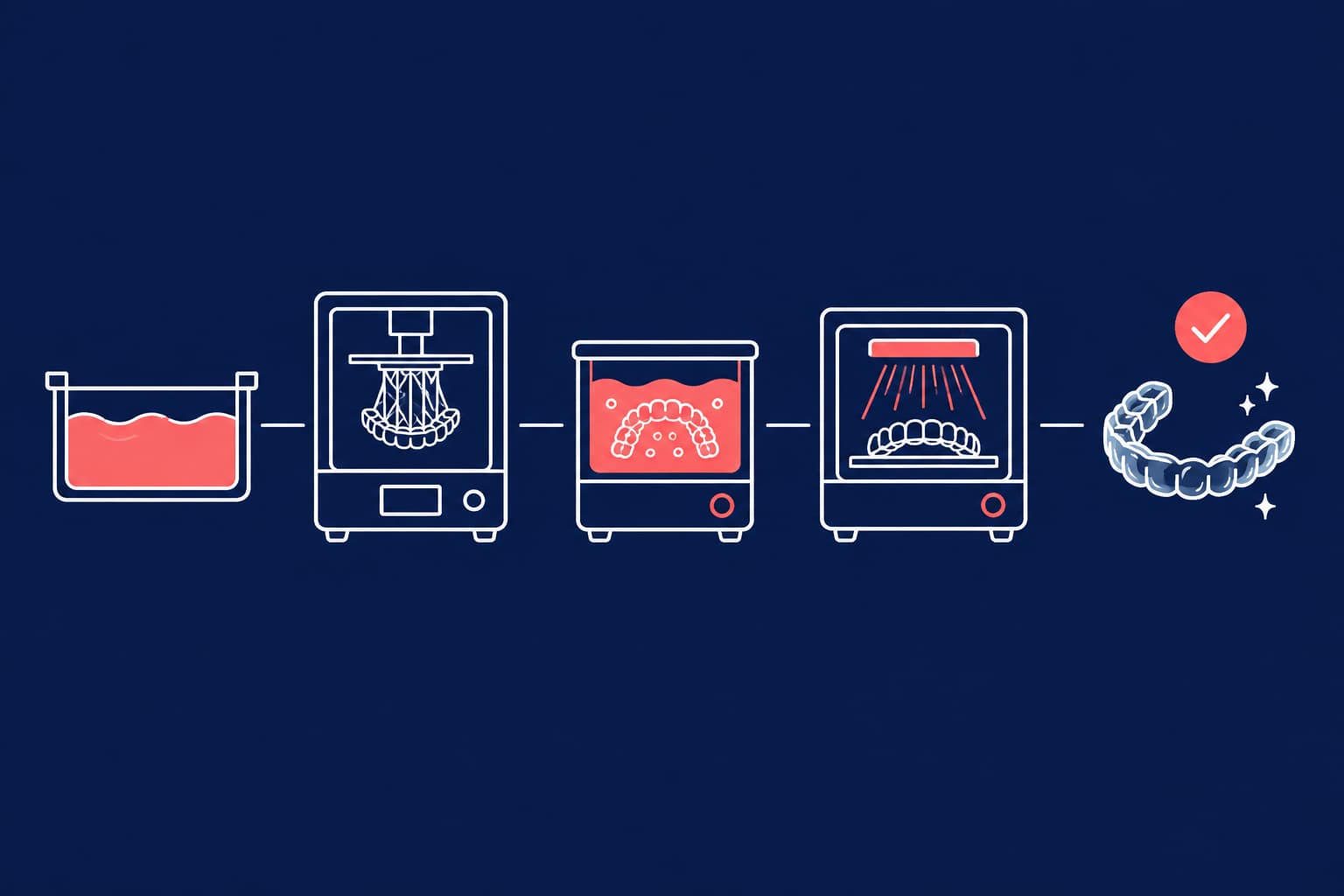
Washing removes uncured resin from the surface. Post-curing finishes polymerisation inside the part. Both steps are variables you control.
Washing. Aligner-specific data show that method matters less than finishing the job. In a review of resins for orthodontic aligners, Tera Harz TC-85 aligners cleaned by centrifugation for 2, 4 or 6 minutes, at room temperature or 55 °C, or by immersion in isopropyl alcohol, all met the ISO 10993-5 criteria. In crown-and-bridge and denture-tooth resins, which are not orthodontic materials but use similar chemistry, cell viability rose steadily as wash time increased from 3 to 90 minutes in both isopropyl alcohol and tripropylene glycol monomethyl ether. In a water-washable crown resin, 20 minutes of water washing reached the same biological performance as organic solvents.
Treat those transfers with care. They show the direction of the effect, not a wash time for your resin. Your resin's instructions for use set the validated protocol.
Post-curing. More is not automatically better. A 2025 systematic review of printed-aligner cytotoxicity covered five studies, four on TC-85 and one on TA-28. Two found no cytotoxic effect. One reported mild cytotoxicity after UV plus heat post-curing, and another reported higher cytotoxicity after extended UV and nitrogen curing. The authors concluded that strict adherence to manufacturer protocols is the safest course, while noting that the small number of studies prevents definitive conclusions.
Other printed dental resins show why too little curing is worse. In two interim-restoration resins, one minute of post-polymerisation sharply reduced keratinocyte viability, while 10 to 20 minutes produced milder effects. In a printed composite, monomer release fell as post-curing went from 0 to 40 minutes, and elution into an ethanol-water solution was higher than into distilled water. Nitrogen atmosphere improved conversion and reduced cytotoxicity in one printed denture base resin, yet extended nitrogen curing worsened results in an aligner study. The effect depends on the specific resin.
Thickness. Thicker parts are harder to cure through. A 2026 study of LuxCreo's DCA resin used the manufacturer's standard 20-minute UV post-cure and found cell viability above 70% at every thickness, from the standard 0.5 mm up to 6 mm. For a thick device such as a palatal expander or a retainer with a bulky acrylic-style base, that kind of thickness-specific evidence matters more than a generic claim. Our guide to 3D-printed palatal expanders covers how those devices are built, and the post-processing guide goes through the wash and cure steps in more detail.
Equipment. Curing depends on wavelength and irradiance. UV at 385 and 405 nm matches the absorption peaks of phosphine-oxide initiators, so a curing unit that does not emit in that range may under-cure a resin regardless of the timer setting. When you compare printers and curing units, how to choose an orthodontic 3D printer lists the criteria that matter.
What the evidence shows for printed and thermoformed aligners
Honest answer: the evidence is encouraging but thin, and nearly all of it is in vitro.
- Pratsinis and colleagues (2022) aged a printed aligner in deionised water for 14 days. Eluates showed no cytotoxicity to human gingival fibroblasts at 20%, 10% or 5% concentration and no estrogenic activity in the cell assays used.
- A review of marketed aligner resins found that, across studies, Tera Harz TC-85 DAC showed no consistent cytotoxicity and no detected estrogenic effect. It also noted that the evidence covers only three marketed resins.
- A 2025 study found borderline results under harsher conditions: Tera Harz reached 69.2% viability after 14 days in saliva with 72-hour incubation, just under the 70% line, and another printed resin, Clear A, reached 62.9% after 7 days.
- A 2026 comparison reported that thermoformed materials and a polyamide-12 system generally held viability above 70%, while several directly printed resins showed larger reductions, approaching moderate cytotoxicity at higher extract concentrations.
Thermoplastics are not free of concern either. In one LC-MS/MS study using artificial saliva, one-day eluates from a thermoformed material (DURAN+) contained low but measurable BPA (154.6 pg/mL) and UDMA (154.8 pg/mL). Most eluates from a printed splint resin (KeySplint Soft) fell below the quantification limits, and after one week all eluates were below them. That compares two specific materials at trace levels, so do not generalise it to all printed versus all thermoformed products.
Aging changes the picture over time. Aligners in saline took up water steadily, stabilising at 8.7% by day 14. A study of three printing resins aged for 15 days in a saliva simulant found residual resin and degradation products released and thermo-mechanical properties reduced. If you want to see how printed appliances are positioned against traditional production, read about direct 3D-printed orthodontic appliances.
What none of this establishes is long-term clinical safety. The honest position for you and your patients is "no signal of harm in the tested conditions", not "proven harmless".
The regulatory layer for labs and clinics in the EU
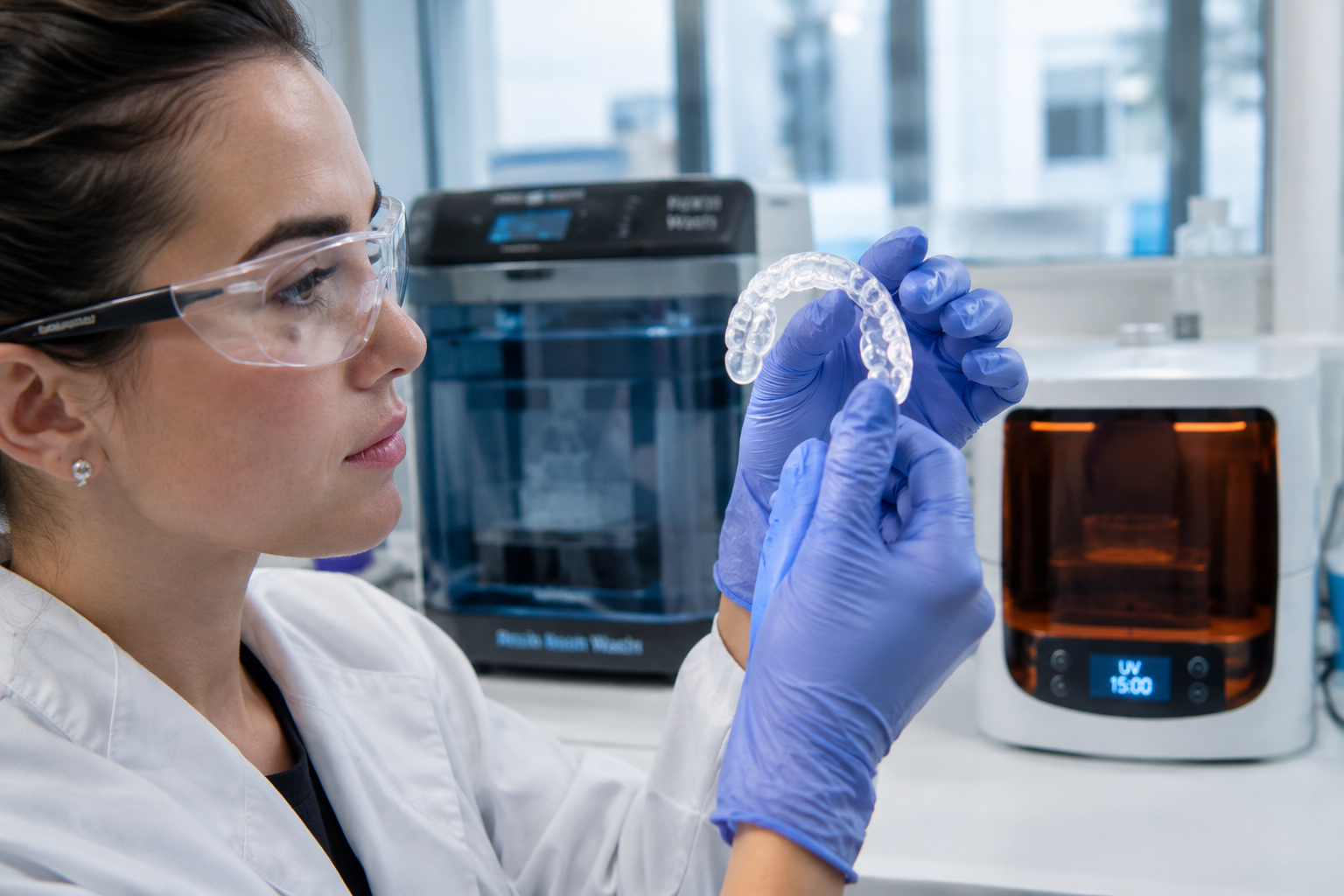
A CE-marked resin does not make every appliance printed from it compliant. A 2025 study of directly printed aligners put the point plainly: the CE certification of Tera Harz TC-85 applies to finished aligners produced in strict adherence to the established protocol, not to the resin as a product.
Several MDR points follow:
- Custom-made status is not automatic. According to MDCG 2021-3, a 3D-printed device qualifies as custom-made only when it follows a written prescription from an authorised person, is intended for one named patient, and is not mass-produced. If it qualifies, the manufacturer follows Annex XIII and draws up the statement before the device is placed on the market.
- CE-marked materials can be components. The same guidance accepts that parts or materials of custom-made devices may themselves be CE-marked, and says the manufacturer's instructions should be followed during further processing.
- Annex I still applies. Devices must be safe, perform as intended and carry acceptable risks, and manufacturers must maintain a documented risk-management system.
Certificate status needs checking, not assuming. A Graphy EC declaration for TC-85DAC and TC-85DAW lists Class IIa under the older Medical Device Directive 93/42/EEC, with a certificate expiry date of 26 May 2024. A separate Graphy test summary lists Class IIa under both the Directive and the MDR, and Graphy's July 2025 regulatory filing stated that it had applied for MDR certification of TA-28 in March 2024 and that MDR review delays had affected the process. LuxCreo states that its DCA resin carries EU CE MDR Class IIa certification. Ask your supplier for the current certificate and notified body details, and file them. Your national competent authority has the final word on what applies to your situation. If you are unsure, take regulatory advice before changing a validated workflow.
A five-step check before you adopt or switch a resin
- Match the intended purpose. Confirm that the resin is certified for the appliance type you make (aligner, retainer, splint, tray) and, for retainers, that its testing covers long-term contact.
- Obtain the current certificate and the instructions for use. Check the regime (MDD or MDR), the expiry date and the validated equipment list.
- Follow the validated post-processing. Use the stated solvent, wash time, curing wavelength, duration and atmosphere. If you change any of them, you are outside what was tested and need your own evidence.
- Read the safety data sheet. Note the photoinitiator and any substance classified as CMR (carcinogenic, mutagenic or toxic for reproduction). If TPO is listed, ask the manufacturer how residual content is controlled after curing.
- Log every batch. Record resin lot, wash solvent change dates, wash time, cure time and the date the curing lamp was last checked. A degraded lamp can quietly turn a validated protocol into an under-cured one.
Replace your wash solvent on a schedule too. Dissolved resin builds up in isopropyl alcohol, and one dimensional-accuracy study found no significant deviations up to 10 wt% resin contamination but clear deviations at 20 wt% and above. That study measured dimensions, not toxicity, yet a contaminated bath is also a worse bath for removing monomer.
When this advice does not apply. Surgical guides and models have different contact durations and risk classes, so the test set differs. LuxCreo, for example, lists its surgical guide resin as MDR Class I. And a resin whose intended purpose excludes intraoral appliances should not be used for one.
Ask your lab for the documents, not just the claim
Biocompatibility in printed orthodontics is a chain, and the weakest link is usually the wash-and-cure step rather than the resin's chemistry. Before your next direct-print case, ask your lab for the resin's current certificate, its validated post-processing protocol and its batch records. Nordicdens works with clinics moving from thermoforming to direct-print appliances, and our guide to orthodontic 3D printing resins is a good place to compare material families before you brief us on a case. If you are specifying retainers, start with 3D-printed retainers and send us the case details you want a protocol for.