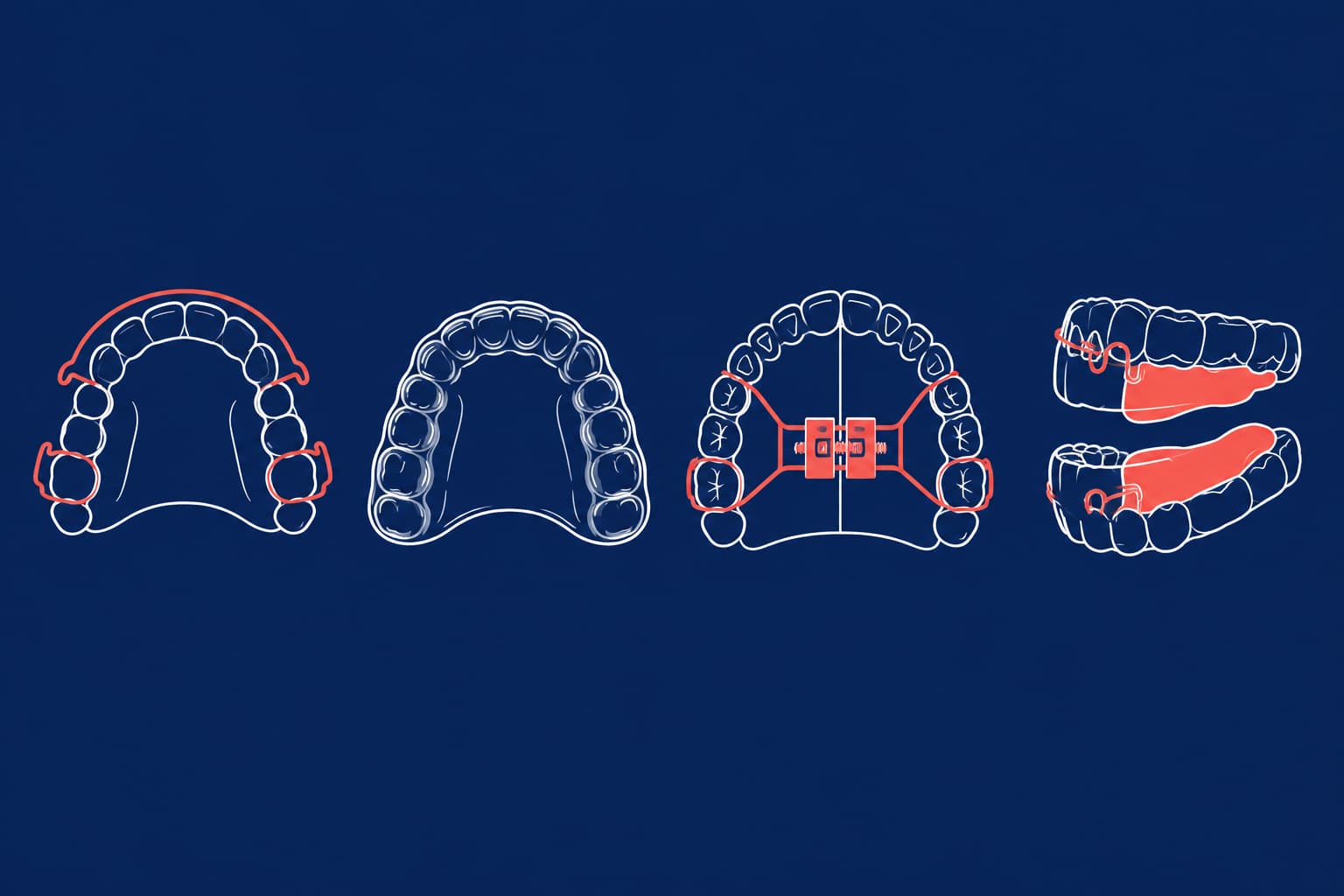
Removable orthodontic appliances are devices the patient inserts and takes out. Four families cover nearly every case: retainers, active plates, functional appliances and clear aligners. All four share one trade-off. You give up chairside control of the force, and in return you get easy hygiene, a lower-cost build and, in growing patients, a way to guide jaw growth. The result depends on how many hours the patient actually wears the device.
This guide explains what each family does, where it stops working, and what a lab has to get right to build it.
| Family | Main job | Typical wear | Lab build |
|---|---|---|---|
| Hawley retainer | Hold teeth after treatment; minor tooth movement with the bow | Can be worn while eating | Acrylic plate, 0.7 mm stainless steel clasps and bow |
| Vacuum-formed retainer (VFR) | Hold teeth after treatment | Usually part-time; never eat or drink with it | Thermoformed sheet, or direct-printed resin |
| Active plate with screw or springs | Small tooth movements, arch expansion | As prescribed | Acrylic plate, clasps, screw or springs |
| Functional appliance (Twin Block, Activator, Bionator, Frankel) | Guide jaw position and growth, mostly Class II | Twin Block: all day except sports, swimming and cleaning | Acrylic and wire, often with screws |
| Clear aligners | Move teeth in sequence | About 22 hours a day | Thermoformed or direct-printed trays |
Retainers: Hawley and vacuum-formed
Retention is the most common use of a removable appliance. The British Orthodontic Society states that retainers are essential in almost all cases once braces come off. Two designs dominate.
A Hawley retainer has an acrylic plate behind the teeth, clasps (usually Adams clasps on the first molars) and a labial wire across the front teeth. The British Orthodontic Society's retention guidelines describe it as robust enough to wear during eating. They also note it helps posterior occlusal settling in the first three months, that the bow can make simple tooth movements, and that an anterior bite plane can be added to hold a corrected deep overbite.
A vacuum-formed retainer (VFR, also called an Essix-type or clear retainer) is a clear shell that covers the teeth. NHS England's retention guidance says VFRs have replaced the Hawley as the removable retainer of choice for most orthodontists, citing excellent fit, comfort and ease of construction.
What the evidence says about Hawley versus VFR
The evidence is thinner than the clinical habit suggests:
- In a randomised trial of 397 patients over six months, VFRs held incisor alignment better than Hawley retainers. The median difference in the lower arch was 0.56 mm. There were otherwise no significant differences.
- The 2023 Cochrane review of retention procedures rates the evidence as low or very low certainty, so it supports no firm ranking.
- Durability findings conflict. One observational study reported a median survival of 1,529 days for Hawley retainers and 105 days for VFRs. A systematic review of randomised trials found no survival difference. The observational VFR group was small (34 retainers), so treat that figure with caution.
- The failure modes differ. In that same study, loss caused 52.0% of Hawley failures, while fracture caused 43.5% of VFR failures.
- Patients prefer VFRs for speech, appearance and gum irritation in a six-month study, yet rate Hawley retainers as more durable. A 24-month randomised trial on expansion cases found similar perceptions and equal stability.
For a practical choice, see our clinical comparison of Hawley and clear retainers. If you want to know how direct printing changes the VFR, read our guide to 3D-printed retainers.
Active plates: screws, springs and their limits
An active plate pairs an acrylic base with clasps for anchorage and a force-delivering element. NHS inform notes that removable braces can carry out only very limited tooth movements. They work best when a case needs a few millimetres of movement, such as an anterior crossbite or a small arch expansion. Teaching texts put the useful range at roughly 1.5 to 2 mm per side.
Screws. A standard expansion screw opens 0.25 mm per quarter turn. Teaching sources advise not exceeding about 1 mm a month, which equals one quarter turn per week and at most two. A worked example: to gain 3 mm you need 12 quarter turns. That takes 12 weeks at one turn a week, or about 6 weeks at two. A screw has a finite range. Ohlendorf Appliance Lab notes that an 8 mm screw allows 32 activations, after which it comes apart. Fit the screw size to the planned expansion, not to the stock catalogue.
Springs. Wire diameter controls how forgiving the appliance is. An Introduction to Orthodontics shows that a 0.5 mm spring needs about 3 mm of activation, while a 0.7 mm spring needs only about 1 mm. The 0.7 mm spring leaves little margin for error: 1.5 mm gives excessive force and 0.5 mm gives too little. When you prescribe springs, specify the wire and the activation you expect.
Where active plates fail. They tip teeth, and they do not translate roots bodily. They also depend entirely on wear time. For a case that needs root control or large movements, a plate is the wrong tool.
For palatal expansion in particular, compare the removable route with fixed designs in our overview of 3D-printed palatal expanders. Our guide to habit-breaking appliances covers a related group in which some designs are removable.
Functional appliances: guiding growth, not moving teeth
Functional appliances use muscle forces and jaw growth to change how the jaws relate. They are used mostly in growing children with Class II malocclusion, and in some mild Class III cases. They contain no active tooth-moving components, so they cannot correct tooth irregularity on their own.
The removable group includes:
- Twin Block. Upper and lower acrylic plates with inclined bite blocks that posture the mandible forward. Screws can widen the upper arch. An NHS leaflet instructs patients to build up wear over the first two to three days, then wear it all the time except for sports, swimming, cleaning and brushing.
- Activator. Developed by Andresen and Häupl in 1908, this is a loose-fitting appliance that the patient holds in place by muscle action.
- Bionator. Originally designed to modify tongue behaviour, it uses a heavy wire loop in the palate and little acrylic there, which makes it easier to wear.
- Frankel regulator. A largely vestibular, tissue-borne design with cheek shields and lip pads that relieve unwanted muscle pressure.
For the lab side of the most common design, see our Twin Block production guide.
Clear aligners as removable appliances
Clear aligners are technically removable, but most professionals discuss them separately from traditional plates. The American Association of Orthodontists describes them as sequential custom trays worn at least 22 hours a day, typically for one week each.
Aligners move teeth well when the movement is tipping or leveling. The published evidence is less encouraging for other movements:
- A 2025 systematic review of rotation found accuracy of 36% to 85%, averaging about 65%, with maxillary canines and premolars the least reliable.
- A 2026 scoping review reported torque under-expressed by 35% to 58%, and suggested over-correction of 50% to 100% for intrusions.
- Compliance is the hidden variable. In a retrospective cohort of 2,644 patients, 45.5% wore each aligner for 22 hours throughout treatment.
Trimming and attachment accuracy then become lab concerns. See our articles on aligner trimming methods and aligner attachment templates.
How a lab builds removable appliances
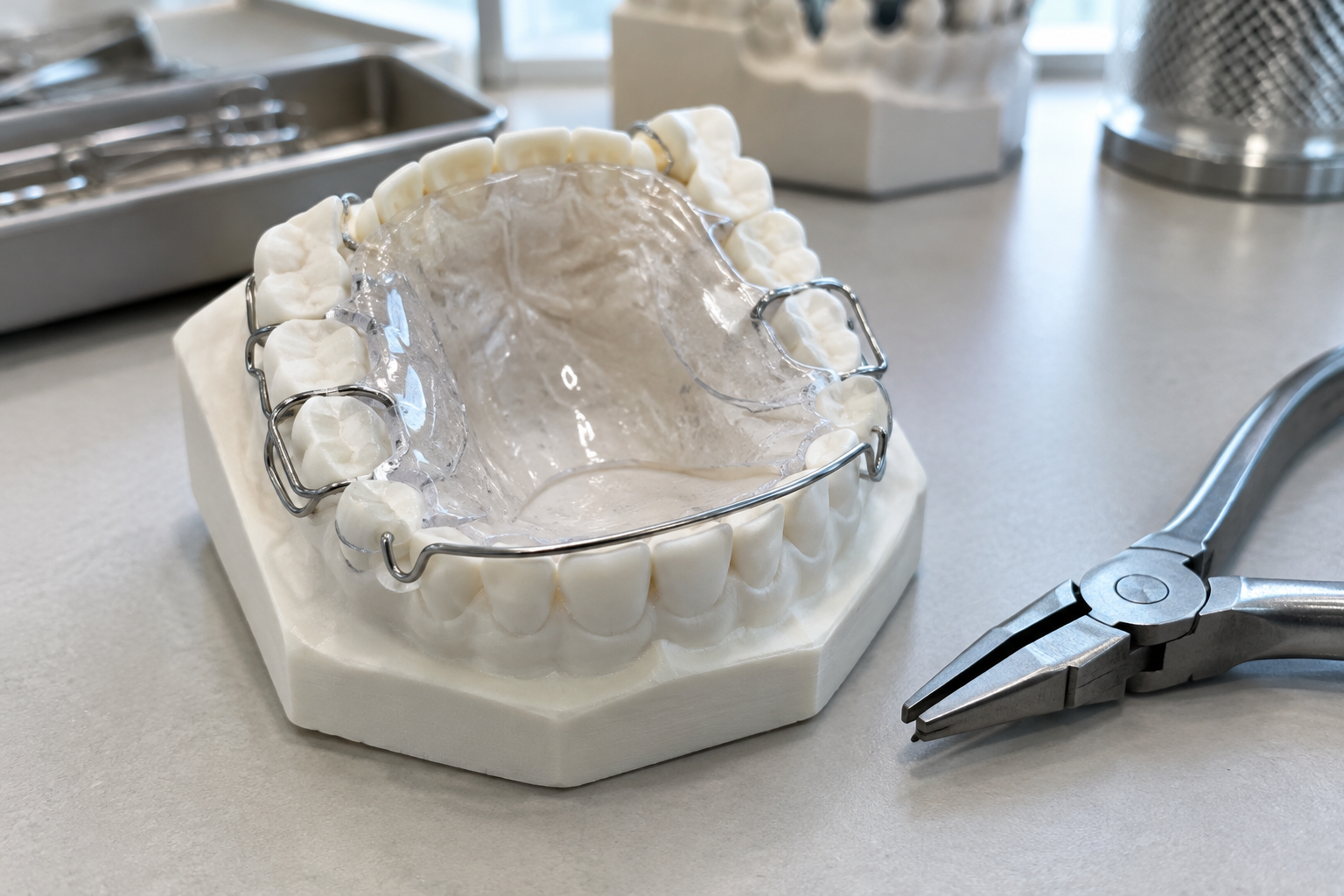
Acrylic and wire
Wire diameter is standardised by function. Adams clasps and labial bows are normally 0.7 mm hard stainless steel wire. A 0.6 mm wire is advised for canines and primary teeth. Canine springs are 0.5 mm. Each clasp has to engage undercuts on the buccal surface, and the arrowheads can be adjusted chairside to tune retention.
Most removable appliances use cold-cure PMMA (polymethyl methacrylate, the acrylic). It shrinks less and keeps better dimensional stability than heat-cure resin, so the plate fits as designed. The price is a lower degree of polymerisation and more residual monomer, which can reduce strength. Research on post-polymerisation (stove or microwave) examines how to offset this. Ask your lab how it post-cures, especially for children's appliances worn all day.
Thermoformed appliances
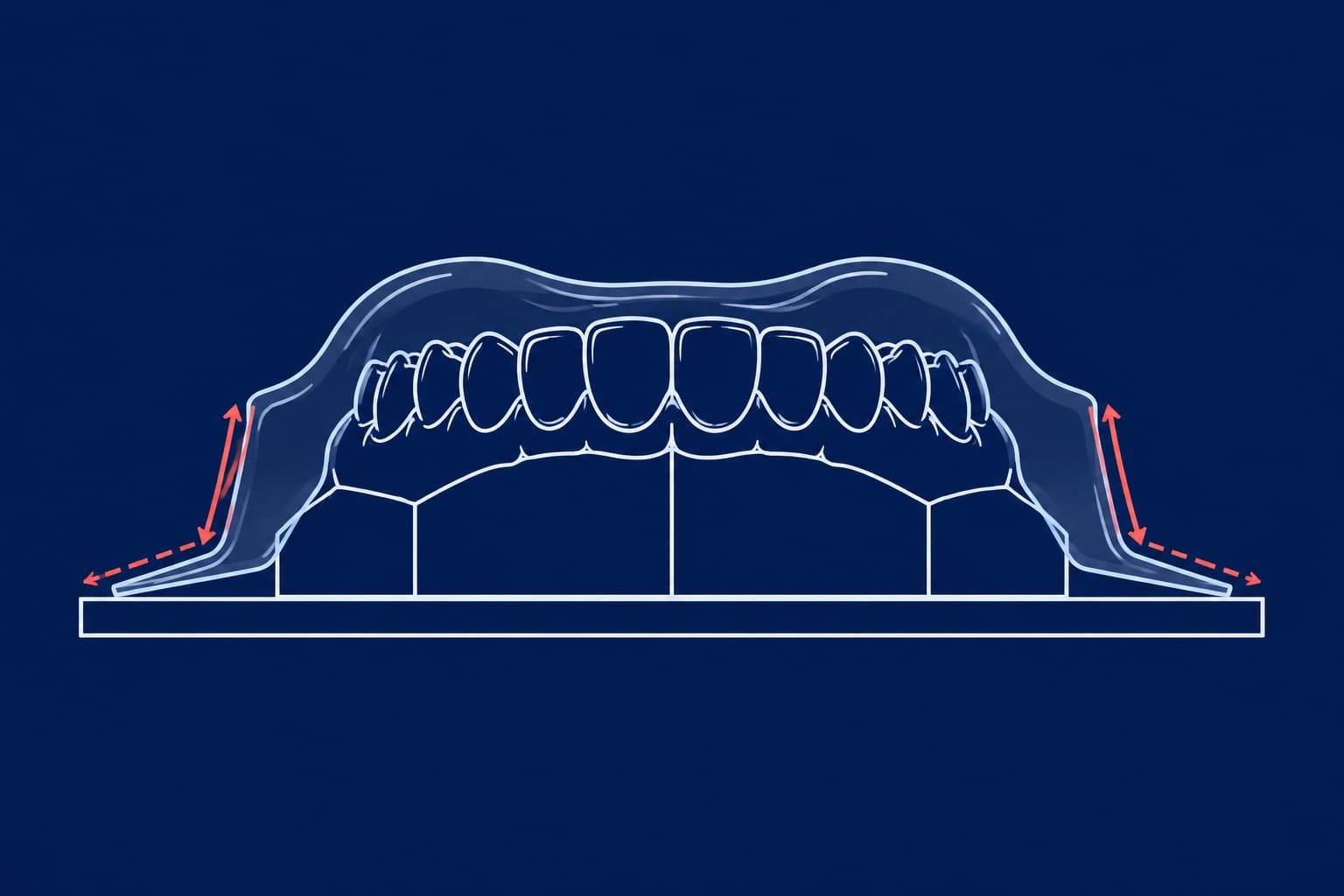
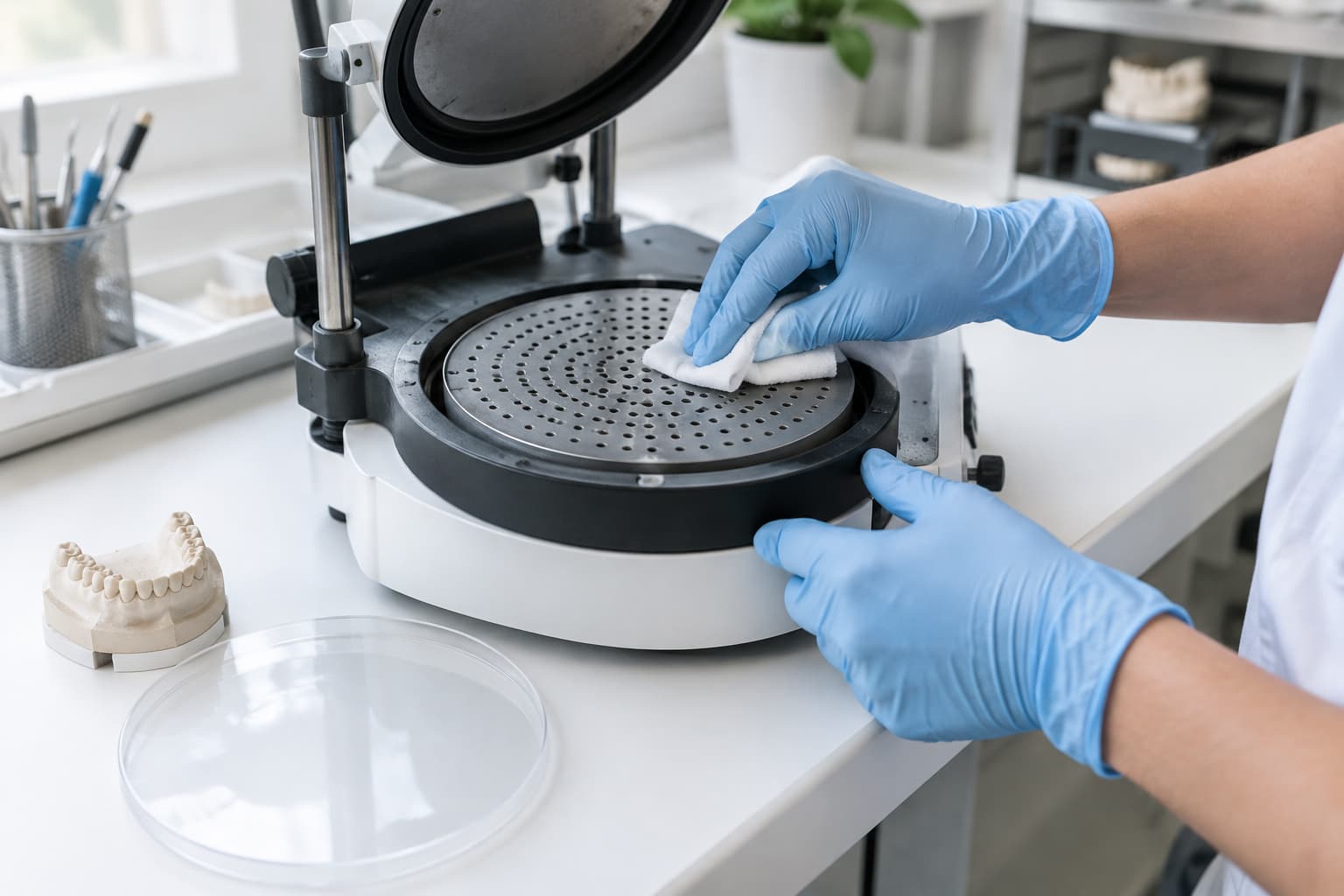
A thermoformed retainer starts from a sheet heated until pliable and pressed over a model. Sheet thickness matters more than most clinics realise. One published description of an Essix-type retainer shows a 1 mm sheet thinning to 0.65 mm after forming. SprintRay recommends 0.75 to 1 mm sheets for retainers, and Formlabs advises against sheets thicker than 1.5 mm because of the heat they need. For the full detail, read our guides on thermoforming in orthodontics and material thickness after forming.
3D-printed appliances
Printing enters the workflow in three ways:
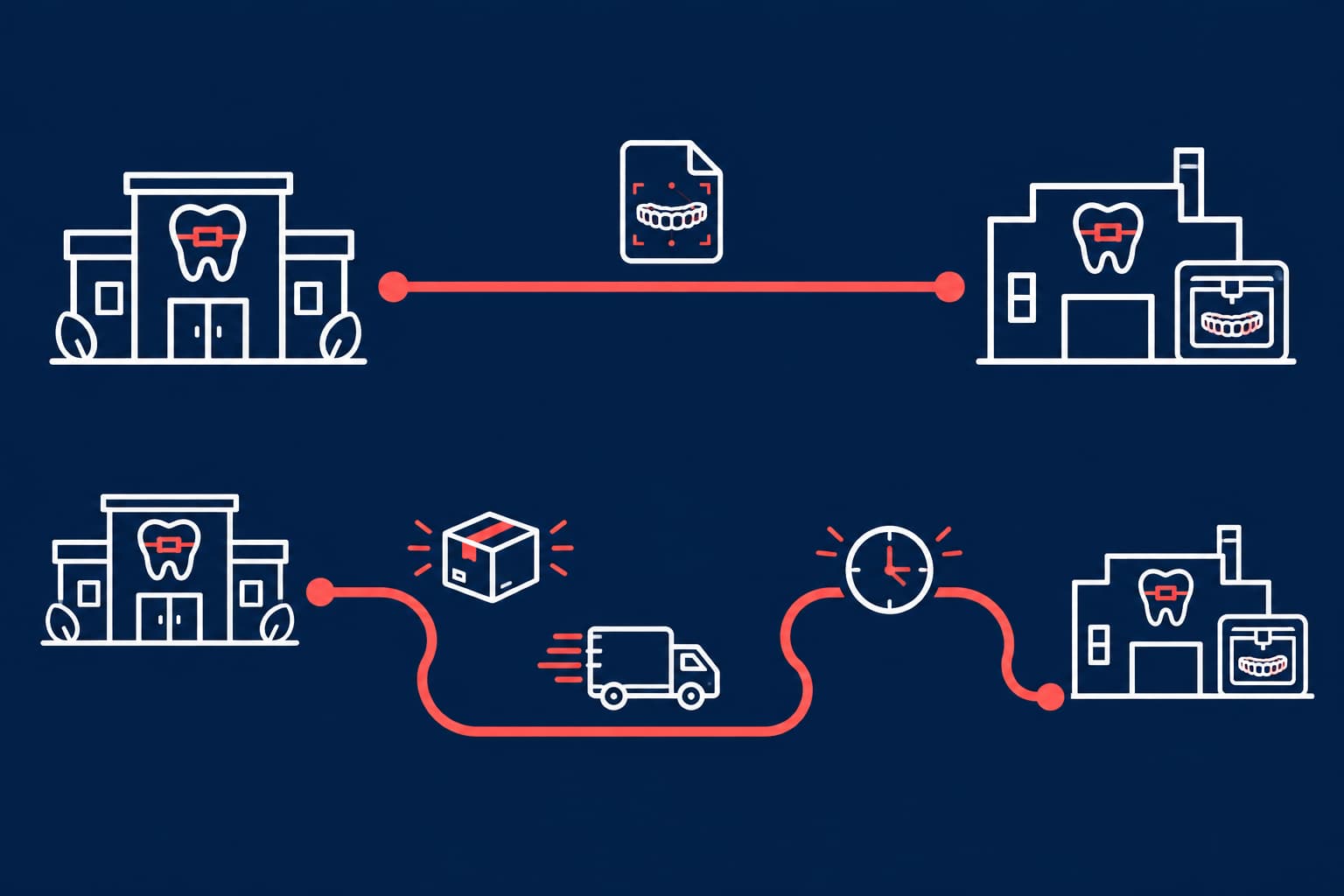
- Printed models. The physical model for a Hawley or a thermoformed shell is printed from a scan instead of poured in stone. Our STL file guide covers the data you need to send.
- Printed acrylic components. A published digital Hawley workflow designed the base plate in 3Shape software, with the alloy clasps and bow made separately and joined to the plate using cold-cure acrylic.
- Direct-printed appliances. Aligners, retainers and even Twin Blocks can be printed in biocompatible resin. A published case report printed Twin Blocks in two patients with Ortho Clear, a Class IIa resin.
Direct printing has a real process risk. A review of aligner materials stresses that incomplete washing or post-curing can leave uncured monomer that may leach into the mouth. Protocols differ by resin. One manufacturer guide for an aligner resin specifies two 3-minute IPA washes. Always follow the instructions for your resin.
The evidence is honest but limited. A 2026 scoping review found only two patient-level studies directly comparing printed and thermoformed appliances. It found no statistically significant superiority for printing. The advantages are in the process, such as digital archives and no physical model. Our guide to direct 3D-printed orthodontic appliances covers the workflow, and choosing an orthodontic 3D printer covers the equipment.
Choosing the right removable appliance
Use these rules as a starting point, not as a protocol:
- Need to hold alignment, and the patient will wear it at night: a VFR, which held incisor alignment better in the largest six-month trial above.
- Need to eat with the retainer, hold a deep overbite, or move a tooth slightly: a Hawley with a bite plane or active bow.
- Need 1 to 2 mm of tipping or a small expansion: an active plate with a screw.
- Growing child with Class II: a functional appliance such as the Twin Block, if the child will wear it nearly full-time.
- Compliance is doubtful: think twice. Every removable appliance fails when it stays in the case. UK NHS trusts also offer bonded (fixed) retainers when a removable one is unsuitable.
Getting your next removable case built
The takeaway is simple: choose the appliance for the movement you need, then choose the build method that suits its wear pattern. Specify wire diameter, screw size, plate coverage and the retention regime on every prescription. For turnaround, our own figures put clear retainers at one to two business days and Hawley or other removable retainers at three to five, because wire bending and acrylic curing take time. Our turnaround guide explains the steps.
Nordicdens builds activators, Twin Blocks, Monoblocks and plate-based appliances with clasps and screws to your prescription. Send your next case as a clean intraoral scan and write your preferred wire, screw and acrylic specification in the prescription. If you are unsure which build suits the case, ask us before you print.